Gyuto vs. Santoku: The Knife Japan's Home Cooks Actually Use
Walk into any knife shop in Japan — whether it's a specialty store in Tokyo's Kappabashi-dori kitchen district, a department store cutlery counter, or the online shelves of Kakaku.com — and you'll find the same question dominating the conversation between shopkeepers and customers: santoku ka, gyuto ka? Santoku or gyuto?
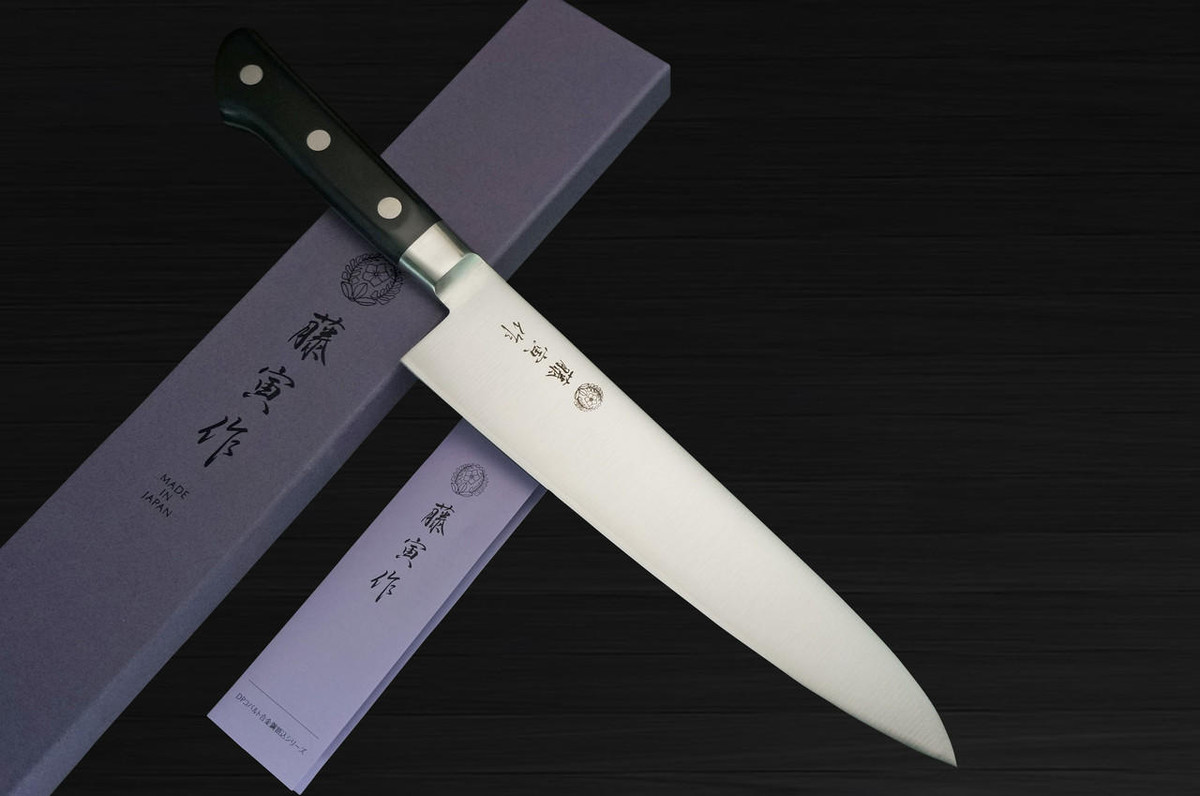
Quick Answer
- The santoku is Japan's most popular home kitchen knife — found in the vast majority of Japanese households and the default "first knife" recommendation from virtually every major Japanese knife manufacturer and kitchen shop
- The gyuto (Japanese chef's knife) is gaining ground among younger cooks and food enthusiasts, driven by its versatility with Western cooking techniques and larger cuts of meat
- The core difference is blade geometry: the santoku's straighter edge excels at the up-and-down push-cutting (*oshi-kiri*) motion used in Japanese cooking, while the gyuto's curved edge is designed for the rocking cut used in Western cuisine
- Size matters more than you think: santoku blades run 165–180mm, while gyuto starts at 180mm and reaches 300mm — in Japan's typically compact home kitchens, that size difference is a practical consideration, not just a preference
Two Knives, One Question Every Japanese Cook Faces
Source: Hocho-Knife.com
Walk into any knife shop in Japan — whether it's a specialty store in Tokyo's Kappabashi-dori kitchen district, a department store cutlery counter, or the online shelves of Kakaku.com — and you'll find the same question dominating the conversation between shopkeepers and customers: santoku ka, gyuto ka? Santoku or gyuto?
It's the fundamental choice in Japanese home cooking. Both knives can handle meat, fish, and vegetables. Both come in carbon steel and stainless varieties. Both are available from budget to ultra-premium price points. So what actually separates them? And which one do Japanese people actually use in their own kitchens?
This article draws on Japanese-language sources including knife manufacturers (Jikko/堺實光, Ichimonji Mitsuhide/堺一文字光秀, Zwilling Japan, Tojiro), knife retailers (Kitchen Paradise, Matsui Hamono), consumer testing publications (LDK, My Best), and home cooking advice platforms to answer that question with data rather than opinion.
What Is a Santoku?
Name, History, and Design
The santoku's full name is santoku bocho (三徳包丁), which translates to "three-virtue knife" or "three-purpose knife." The three "virtues" refer to its ability to handle the three main categories of kitchen ingredients: meat (niku), fish (sakana), and vegetables (yasai). It's a general-purpose knife designed for the home kitchen, developed in the early-to-mid 20th century as Japan's cooking culture began incorporating more Western-style meat dishes alongside traditional Japanese cuisine.
The santoku was specifically engineered as a domestic alternative to the traditional nakiri (vegetable knife) and the Western-imported gyuto. It borrowed the nakiri's flat-ish edge profile and the gyuto's pointed tip, creating a hybrid that could handle the full range of Japanese home cooking tasks in a single, manageable blade.
Physical Characteristics
Blade length: 165–180mm (typically 165mm or 170mm for home use) Blade shape: Wide, with a relatively flat edge that curves gently upward toward the tip. The tip itself is rounded (sori — a gentle, sheep's-foot-like curve), not pointed like a gyuto's. Blade height: Taller (wider from spine to edge) than a gyuto of equivalent length, providing more knuckle clearance on the cutting board. Weight: Light. Most santoku knives weigh 100–170g, making them comfortable for extended prep sessions. Balance point: Typically at or slightly forward of the handle junction, creating a balanced feel that doesn't require wrist effort to control.
The Jikko (堺實光) professional knife guide describes the santoku as having "a blade edge with a gentle curve and relatively straight lines, with a crescent-shaped (mikazuki-gata) tip" — distinguishing it clearly from the gyuto's pronounced curvature (Source: jikko.jp, "Santoku Bocho vs. Gyuto").
Cutting Technique: Push-Cut (Oshi-kiri)
The santoku's flat edge profile is optimized for the push-cut technique (oshi-kiri, 押し切り) — pressing the blade forward and downward in a single, clean motion. This is the dominant cutting technique in Japanese home cooking. Ichimonji Mitsuhide describes it as a "ton, ton" rhythm — a rapid up-and-down chopping motion where the blade contacts the board along its full length each time.
Because more of the santoku's edge sits flat against the cutting board simultaneously, it produces very clean, even cuts through vegetables. Thin cucumber slices, julienned carrots, minced ginger — the santoku handles all of these with precision. The wide blade also doubles as a scoop for transferring chopped ingredients from the board to the pot.
What Is a Gyuto?
Name, History, and Design
Gyuto (牛刀) literally translates to "beef sword" — a name that reveals its origins. The gyuto entered Japan as a Western-style chef's knife during the Meiji era (1868–1912), when Japan's government actively encouraged the adoption of Western customs, including beef consumption (previously restricted by Buddhist dietary practices). As Japanese cooks began preparing more meat dishes, they needed a knife designed for the task, and the French chef's knife became the template.
Over the past century, Japanese makers have refined the gyuto into something distinct from its Western ancestor. Japanese gyuto are typically lighter, thinner, ground at more acute angles (12–15 degrees per side versus 20+ degrees for Western chef's knives), and often use harder steels that hold a sharper edge. A Japanese gyuto and a German chef's knife may look similar at a glance, but they feel completely different in the hand.
Physical Characteristics
Blade length: 180–300mm (most common home sizes are 180mm and 210mm; professional lengths run 240mm–300mm) Blade shape: Long and tapered, with a pronounced curve from heel to tip. The tip is sharply pointed — useful for detail work, scoring, and piercing. Blade height: Narrower (less height from spine to edge) than a santoku of comparable length. The gyuto trades knuckle clearance for a more agile, pointed profile. Weight: Varies widely by length and construction. A 210mm gyuto typically weighs 150–200g; longer professional models can exceed 250g. Balance point: Shifts depending on length and construction. Shorter gyuto (180mm) handle similarly to a santoku; longer models (240mm+) require more intentional technique.
Multiple Japanese sources — including Jikko, Ichimonji Mitsuhide, and Zwilling Japan — describe the gyuto as having "a sharp, pointed tip and a large curve from blade base to tip" that distinguishes it from the santoku's flatter profile (Source: jikko.jp; ichimonji.co.jp; zwilling.com/jp).
Cutting Technique: Rock-Cut and Slice
The gyuto's curved blade is designed for two techniques rarely used with a santoku:
Rock-cutting (yusuri-kiri): Placing the tip of the blade on the cutting board and rocking the handle down through the ingredient. This is the dominant technique in Western professional kitchens and is increasingly popular among Japanese cooks preparing Western dishes. The gyuto's curve provides the continuous blade-to-board contact that makes rocking work.
Long slicing strokes: The gyuto's length allows for smooth, drawn-out slicing motions — pulling the blade from heel to tip through a piece of meat, for example. This is essential for breaking down larger cuts that Japanese cooking increasingly incorporates (roast chicken, pork loin, beef steak preparation).
The gyuto's pointed tip also enables precision work that the santoku's rounded tip cannot: piercing into food (scoring bread dough or poultry skin), making fine incisions (trimming silverskin from meat), and detail cutting in tight spaces.
Head-to-Head Comparison
| Feature | Santoku | Gyuto |
|---|---|---|
| Japanese name meaning | "Three virtues" (meat, fish, vegetables) | "Beef sword" |
| Typical blade length | 165–180mm | 180–300mm |
| Blade profile | Flat edge, rounded tip | Curved edge, pointed tip |
| Primary cutting motion | Push-cut (oshi-kiri) | Rock-cut, long slice |
| Best for | Vegetables, boneless proteins, precision | Meat, large items, versatile technique |
| Knuckle clearance | Excellent (wide blade) | Moderate (narrower blade) |
| Tip work capability | Limited (rounded tip) | Excellent (sharp point) |
| Learning curve | Lower — intuitive push-cut motion | Moderate — benefits from technique practice |
| Compact kitchen suitability | Excellent — short, maneuverable | Good at 180mm; challenging at 210mm+ |
| Common in Japanese homes | Dominant — found in most households | Growing — especially among younger cooks |
What Japanese Home Cooks Actually Choose
The Santoku's Dominance
The santoku is, without question, the standard knife in Japanese home kitchens. Every Japanese source consulted for this article confirms this.
Ichimonji Mitsuhide (堺一文字光秀), one of Sakai's most respected knife shops, states directly: "In Japan, the santoku bocho is used in the vast majority of general households" (Source: ichimonji.co.jp, "Santoku to Gyuto no Chigai").
Kitchen Paradise, a Fukuoka-based kitchen equipment retailer, conducted an internal survey of their staff — all experienced home cooks — and found that "nearly all staff members named the santoku as their most frequently used knife" (Source: kitchenparadise.com, "Santoku Bocho to Gyuto no Chigai").
The reasons for this dominance are practical, not just cultural:
-
Size fits Japanese kitchens. Japanese home kitchens are small — often with counter space measured in inches, not feet. A 165mm santoku fits comfortably in these spaces. A 240mm gyuto feels like wielding a katana.
-
Push-cutting matches Japanese cooking. The majority of Japanese home cooking involves vegetable-forward dishes: stir-fries, simmered vegetables (nimono), salads, miso soup. The santoku's flat edge is purpose-built for the rapid vegetable prep these dishes require.
-
Lighter weight reduces fatigue. Japanese home cooks (historically and predominantly women) cook 1–3 meals per day. A light santoku reduces wrist and hand fatigue over the cumulative hours of daily cooking — a factor that shows up repeatedly in Japanese knife reviews on Kakaku.com.
-
Lower intimidation factor. Multiple Japanese knife shops note that the santoku's compact, non-aggressive shape is psychologically more approachable for beginners. Matsui Hamono (松井刃物) specifically recommends the santoku for "beginners or those not accustomed to using knives" (Source: matsui-hamono.com, "Santoku Bocho to Gyuto no Chigai to wa?").
The Gyuto's Rising Popularity
But the landscape is shifting. Multiple Japanese sources describe a growing preference for the gyuto, particularly among:
- Younger cooks who watch Western-style cooking content on YouTube and social media
- Men who cook — Japanese media often positions the gyuto as the more "serious" or "professional" choice
- Cooks who prepare Western dishes frequently — pasta, steak, roast chicken, and other dishes that benefit from the gyuto's length and tip
The Impress Watch technology and lifestyle site published an article titled "A gyuto may be more versatile than a santoku!?" — framing the gyuto as the emerging recommendation for home cooks willing to learn its technique (Source: watch.impress.co.jp, "Hocho wa Santoku yori mo Gyuto ga Banno!?").
Jikko's comparison page notes that "the gyuto is recommended for those who are accustomed to using knives and want to expand their cooking repertoire" — positioning it as a graduation from the santoku rather than a replacement (Source: jikko.jp).
The Size Factor
One aspect that rarely gets enough attention in Western knife discussions but dominates Japanese conversations: blade length.
The standard santoku is 165mm. The standard gyuto is 210mm. That's a 45mm difference — almost 2 inches — which matters enormously in a Japanese home kitchen where the cutting board might be 300mm wide and the counter barely accommodates the board plus a pot.
Multiple Japanese knife shops specifically address this by recommending the 180mm gyuto as the ideal compromise — it provides the gyuto's curved blade profile and pointed tip while remaining compact enough for small kitchens. Zwilling Japan explicitly frames the 180mm gyuto as "suitable for household use" while noting that 210mm and above are "professional sizes" (Source: zwilling.com/jp, "Gyuto to wa?"). At 180mm, the size difference between a gyuto and a 165mm santoku shrinks to just 15mm — making the choice genuinely about technique preference rather than space constraints.
Choosing by Cooking Style
Choose the Santoku If...
- You cook mostly Japanese or Asian dishes — stir-fries, nimono (simmered dishes), miso soup, rice bowls, and other vegetable-forward preparations
- You prefer the push-cut technique — the up-and-down chopping motion that produces clean, even slices
- Your kitchen is compact — the santoku's shorter blade maneuvers easily in tight spaces
- You're a beginner — the intuitive shape and balanced weight make it immediately comfortable
- You want one knife that does everything adequately — the santoku is the Swiss Army knife of the Japanese kitchen
- You frequently scoop ingredients off the cutting board — the wide blade doubles as a bench scraper
Choose the Gyuto If...
- You cook a mix of Japanese and Western dishes — or lean toward Western cooking (pasta, roasts, steaks, stews)
- You work with large cuts of meat or whole poultry — the gyuto's length handles these better
- You use the rocking cut — mincing herbs, garlic, and aromatics with a rocking motion
- You want precision tip work — scoring, piercing, and fine detail cutting
- You have comfortable counter space — at least enough for a standard cutting board without crowding
- You're upgrading from a santoku — and want a knife that expands what you can do
The "Why Not Both?" Approach
In professional Japanese kitchens and increasingly in enthusiast home kitchens, the answer is simply: own both. A 165mm santoku for quick vegetable prep and daily cooking, and a 210mm (or 180mm) gyuto for meat work, larger prep jobs, and Western-technique cooking. The two knives complement each other perfectly because their strengths cover each other's gaps.
This "two-knife system" (sometimes expanded with a petty knife as the third piece) is the setup recommended by most Japanese knife professionals. Ichimonji Mitsuhide's guide page explicitly walks customers through this progression: santoku first, gyuto second, petty third (Source: ichimonji.co.jp).
Steel and Construction Considerations
 Source: Hocho-Knife.com
Both santoku and gyuto knives are available in every steel type common in Japanese knife-making:
Stainless (VG-10, MoV, Ginsan): The most popular choice for home use. Low maintenance, corrosion resistant, and widely available at all price points. If you're buying your first serious Japanese knife, stainless is the pragmatic choice.
Carbon (Shirogami, Aogami): Sharper edge potential and easier sharpening, but requires diligent maintenance to prevent rust. More common in professional settings and among knife enthusiasts. Our complete steel guide covers the differences between these steels in detail.
Damascus-clad: A hard core steel (often VG-10) wrapped in layers of softer Damascus-pattern stainless. Functional benefit is minimal — the Damascus cladding reduces food sticking slightly and protects the core — but the visual appeal drives significant purchase decisions, as the Kakaku.com rankings demonstrate.
Construction note: Both santoku and gyuto are available in both wa-handle (traditional Japanese octagonal or D-shaped wooden handle) and yo-handle (Western-style riveted handle) configurations. Wa-handles are lighter and shift the balance toward the blade; yo-handles are heavier and provide a more centered balance. The choice is personal preference — neither is objectively superior.
Price Guide: What to Expect at Each Level
Santoku Pricing (Japanese Domestic Market)
| Tier | Price Range | What You Get | Example |
|---|---|---|---|
| Entry | ¥1,500–¥3,000 | MoV stainless, basic handle, Seki-made | Kai Seki Magoroku Akane |
| Mid-range | ¥3,000–¥8,000 | VG-10 or premium stainless, better handle | Tojiro DP, Yaxell Premio |
| Premium | ¥8,000–¥15,000 | Damascus, hand-finished, premium handle | Kai Seki Magoroku Damascus |
| Artisan | ¥15,000–¥40,000+ | Hand-forged, carbon steel, named maker | Sakai/Echizen artisan pieces |
Gyuto Pricing (Japanese Domestic Market)
| Tier | Price Range | What You Get | Example |
|---|---|---|---|
| Entry | ¥2,000–¥4,000 | MoV stainless, 180mm, basic construction | Tojiro Economy, Kai basic |
| Mid-range | ¥4,000–¥10,000 | VG-10, 180–210mm, quality handle | Tojiro DP, GLOBAL G-2 |
| Premium | ¥10,000–¥20,000 | Pro-grade stainless or carbon, 210mm | Misono UX10, Masahiro MV |
| Artisan | ¥20,000–¥60,000+ | Hand-forged, named maker, 210–240mm | Sakai/Echizen master crafted |
For international pricing, expect a 30–50% premium over Japanese domestic prices. Use our knife finder tool to compare current international pricing.
The Professional Perspective
While this article focuses on home kitchen use, it's worth noting how the santoku/gyuto divide plays out professionally.
Washoku (Japanese cuisine) chefs typically use neither a santoku nor a gyuto as their primary knife. Instead, they rely on specialized single-bevel knives — the yanagiba for sashimi, the deba for fish butchery, and the usuba for vegetables. The santoku and gyuto are both considered "household knives" (kateiyo hocho) in the professional washoku world. These chefs get their knives from Sakai, where single-bevel craftsmanship commands ~90% of the professional market.
Western cuisine chefs in Japan overwhelmingly use the gyuto. It's the Japanese equivalent of a French chef's knife, and its presence in professional Western kitchens is universal. Professional gyuto lengths typically start at 210mm and go up to 270mm or 300mm — significantly longer than what's practical for home use.
Home cooking instructors and food media in Japan default to recommending the santoku for beginners and the gyuto as an upgrade or complement. This recommendation pattern has been consistent across every Japanese source consulted for this article.
Maintaining Either Knife
Whether you choose a santoku or gyuto, maintenance requirements are identical for the same steel type:
For stainless steel knives: Hand wash with mild detergent, dry immediately (or air dry on a rack), and sharpen on a whetstone every 2–4 weeks for home use. Avoid dishwashers — the vibration and harsh chemicals accelerate edge degradation.
For carbon steel knives: Wash and dry immediately after every use. Wipe the blade between cuts when working with acidic foods. Apply a thin layer of camellia oil (tsubaki abura) before storage. Sharpen more frequently — carbon steel dulls faster but resharpens much more easily.
For both: Use a wooden or soft plastic cutting board. Never cut on glass, ceramic, marble, or metal surfaces. Store on a magnetic strip, in a knife block, or in individual blade guards — never loose in a drawer where edges contact other utensils.
Frequently Asked Questions
Can a santoku do everything a gyuto can?
Almost, but not quite. The santoku handles 90% of home cooking tasks — chopping, slicing, dicing, mincing — as well or better than a gyuto, thanks to its optimized push-cut geometry and compact size. Where the santoku falls short: breaking down very large ingredients (whole cabbages, large squash), making long slicing cuts through large cuts of meat, precision tip work (scoring, piercing), and the rocking-cut technique used for fine herb mincing. If your cooking doesn't regularly involve these tasks, a santoku alone is sufficient.
What size gyuto should I buy for home use?
180mm is the consensus recommendation for Japanese home kitchens from virtually every knife manufacturer and retailer consulted. It provides the gyuto's characteristic curved blade and pointed tip while remaining compact enough for small counters and cutting boards. The 210mm gyuto — the standard in professional Western kitchens — is suitable for home cooks with spacious kitchens and larger cutting boards. Go 210mm if you regularly work with large cuts of meat; stay with 180mm if you value maneuverability in a compact space.
Is it true that the gyuto is "better" than the santoku?
No. This framing, which sometimes appears in Western knife culture, misunderstands the relationship. The santoku is purpose-built for the push-cut technique that dominates Japanese cooking. The gyuto is purpose-built for the rock-cut and slicing techniques of Western cooking. Neither is universally superior — they're optimized for different cutting motions and ingredient profiles. The "best" knife is the one matched to how you actually cook.
Why do Japanese knife shops recommend the santoku for beginners?
Four reasons, consistently cited across Japanese sources: (1) the shorter blade is easier to control and less intimidating, (2) the balanced weight doesn't fatigue the wrist during learning, (3) the push-cut technique is simpler to execute correctly than the rocking cut, and (4) the flat edge profile is more forgiving of angle inconsistency — even imperfect technique produces acceptable cuts. Matsui Hamono summarizes it as "the santoku is recommended for beginners or those not accustomed to using knives."
Should I buy both?
If you cook regularly and have the budget for two quality knives, yes. The santoku + gyuto combination is the most recommended two-knife setup in Japanese knife culture — equivalent to the "chef's knife + paring knife" foundation in Western kitchens. Start with whichever matches your dominant cooking style, then add the other when you're ready to expand. Compare steels and models with our steel comparison tool, and browse options in our maker database.
Related Reading
- Sakai vs. Seki vs. Echizen: Japan's Three Knife-Making Capitals Compared
- The Beginner's Guide to Japanese Knife Steel: Shirogami, Aogami, and VG-10 Explained
- The 10 Best Japanese Knives on Kakaku.com: Translated Rankings and Reviews
— The Blade & Steel Team