The Art of Japanese Knife Handles: Wa vs. Yo Explained
New knife buyers obsess over steel. Shirogami vs. Aogami. VG-10 vs. ZDP-189. Carbon vs. stainless. That's understandable — steel determines sharpness, edge retention, and maintenance demands.

Quick Answer
- Wa-handles (和柄) are the traditional Japanese knife handle: a lightweight wooden cylinder inserted into the blade's tang, designed for the pinch grip favored by Japanese cutting techniques — replaceable, ergonomic, and available in materials from affordable ho wood (朴) to heirloom-grade ebony (黒檀)
- Yo-handles (洋柄) are the Western-style riveted handle: two slabs of material sandwiching a full or partial tang, secured with rivets — heavier, more robust, and the default for Western chef's knives sold worldwide
- The handle choice changes the knife's balance point by 15–30mm, fundamentally altering how the blade feels in motion — wa-handles shift weight forward toward the blade, while yo-handles center weight in the hand
- Neither is objectively better — the right handle depends on your grip style, cutting technique, and whether you prioritize agility (wa) or stability (yo), according to sources from Tojiro, Jikko, and Takahashi Kusu
Why the Handle Matters More Than Most People Think
 Source: Hocho-Knife.com
New knife buyers obsess over steel. Shirogami vs. Aogami. VG-10 vs. ZDP-189. Carbon vs. stainless. That's understandable — steel determines sharpness, edge retention, and maintenance demands.
But talk to any professional chef in Japan, and they'll tell you: the handle is at least half the knife. You don't feel steel when you cook. You feel wood, or plastic, or riveted composite pressing into your palm for hours. The handle determines grip security, fatigue, balance, and that hard-to-define sense of whether a knife feels like an extension of your hand or a foreign object you're wrestling with.
This guide covers every aspect of Japanese knife handles — wa and yo — drawing on Japanese-language sources from Jikko (堺實光), Tojiro (藤次郎), Takahashi Kusu (高橋楠), Suisin (酔心), Ichimonji Mitsuhide (堺一文字光秀), Fukube Kaji (ふくべ鍛冶), and knife collectors' resources to give you a complete picture.
Wa-Handle: The Japanese Tradition
Construction
A wa-handle (和柄, literally "Japanese handle") is a wooden cylinder with a hollow bore at one end. The blade's tang (nakago) — a narrow, pointed extension of steel — is heated and driven into the bore. The tang's heat chars the inside of the wood, creating a tight friction fit as the wood contracts around the cooled metal.
This is the push-in tang or hidden tang construction. No rivets, no bolts, no adhesive in traditional construction. Just wood gripping metal.
The top of the handle — where it meets the blade — is fitted with a ferrule (kuchi-wa or katsura, 口輪/桂) made from buffalo horn, plastic, or metal. This ferrule serves two purposes: it prevents the wood from splitting when the tang is inserted, and it creates a seal that reduces moisture migration into the handle bore.
Tojiro's technical guide describes the wa-handle as "a push-in structure where the blade's tang is inserted into a pre-bored handle, secured by the friction between the charred bore wall and the tang" (Source: tojiro.net, "Handle Structure").
Handle Materials
The wood and ferrule materials define both the price and character of a wa-handle. Japanese knife sources consistently describe these tiers:
Wood Species
Ho wood (朴 — ho): The standard. Ho wood has a specific gravity of approximately 0.49–0.50, making it one of the lightest handle materials. It's water-resistant, easy to shape, widely available, and has a neutral feel. Found on the vast majority of Japanese knives from entry-level to mid-range professional. Jikko describes ho wood as "the base material for wa-handles — light, water-resistant, and suitable for long hours of use" (Source: jikko.jp, "Knife Handle Materials").
Magnolia (朴 compressed / 圧縮朴): Densified ho wood with improved hardness and water resistance. A step up from standard ho without a dramatic price increase.
Chestnut (栗 — kuri): Specific gravity approximately 0.55. Harder and slightly heavier than ho wood. Has a warm, golden color. Used in mid-range handles.
Cherry (桜 — sakura): Beautiful grain, mid-weight, but less commonly used for knife handles than in furniture or craft work. Occasionally found on artisan knives.
Rosewood / Shitan (紫檀): Specific gravity approximately 1.04. Dense, heavy, and dramatically beautiful — deep reddish-brown with visible grain. Popular with foreign buyers, according to RE-Knife, which notes that "shitan handles are especially popular among international knife collectors for their color and weight" (Source: re-knife.com). The English name "rosewood" contributes to this international appeal.
Ebony / Kokutan (黒檀): Specific gravity approximately 1.09. The prestige material. Jet black, extremely hard, nearly waterproof. Ebony handles are fitted to the highest-grade professional knives and carry significant price premiums — often ¥5,000–¥15,000 more than the same blade with a ho-wood handle. Takahashi Kusu describes ebony as "the ultimate handle material, coveted by professional chefs as a mark of their craft" (Source: takahashikusu.co.jp, "Wa-Handle Guide").
Keyaki / Zelkova (欅): A Japanese hardwood with beautiful grain. Less common but prized for custom handles.
Ferrule Materials
Plastic (PC): The most affordable option. Found on entry-level and home-use knives. Functional but lacks the aesthetic and feel of natural materials.
Water buffalo horn (水牛角 — suigyuu-no-tsuno): The professional standard. Takahashi Kusu states that "the water buffalo horn ferrule is the most commonly used among professional chefs" (Source: takahashikusu.co.jp). The horn is naturally dark, hard, and resistant to splitting. It develops a subtle patina with years of use.
Black buffalo horn (黒水牛): Higher-grade water buffalo horn selected for uniform black color. Used on premium knives.
Ebony ring: Sometimes used on all-ebony handles for a seamless look. Rare and expensive.
Handle Shapes
Wa-handles come in three standard shapes, each suited to different knives and hand sizes:
Round (丸 — maru): A simple cylinder. Most common on deba (fish-butchery knives) where the cook needs to rotate the knife freely in the hand for various angled cuts. Also found on home-grade knives. The round shape distributes grip pressure evenly but provides no rotational index — your hand can't feel which way the blade faces without looking.
D-shape / Shinogi (シノギ / 栗型): A modified oval with one flat side. The flat indicates blade orientation by feel — critical for professional chefs who make thousands of cuts per shift without looking at the blade. Standard on yanagiba (sashimi knives) and usuba (vegetable knives). Jikko notes that "shinogi handles are preferred for single-bevel knives where the chef must maintain consistent blade orientation" (Source: jikko.jp).
Octagonal (八角 — hakkaku): Eight-sided. The most premium shape. The facets lock into the fingers, providing excellent grip security and rotational indexing. Suisin (酔心) describes the octagonal handle as "slightly more high-grade, typically fitted to quality blades" (Source: suisin.co.jp). Common on high-end gyuto, yanagiba, and specialty knives.
Yo-Handle: The Western Import
Construction
The yo-handle (洋柄, literally "Western handle") follows the European/American knife construction tradition. The blade's tang extends into the handle as a flat, wide piece of steel. Two handle scales (slabs of material) are placed on either side of the tang and secured with two or three rivets, creating a sandwich.
This is the full-tang or partial-tang riveted construction. The tang is visible as a line of metal running between the handle scales along the top and bottom edges.
Key Structural Differences from Wa-Handles
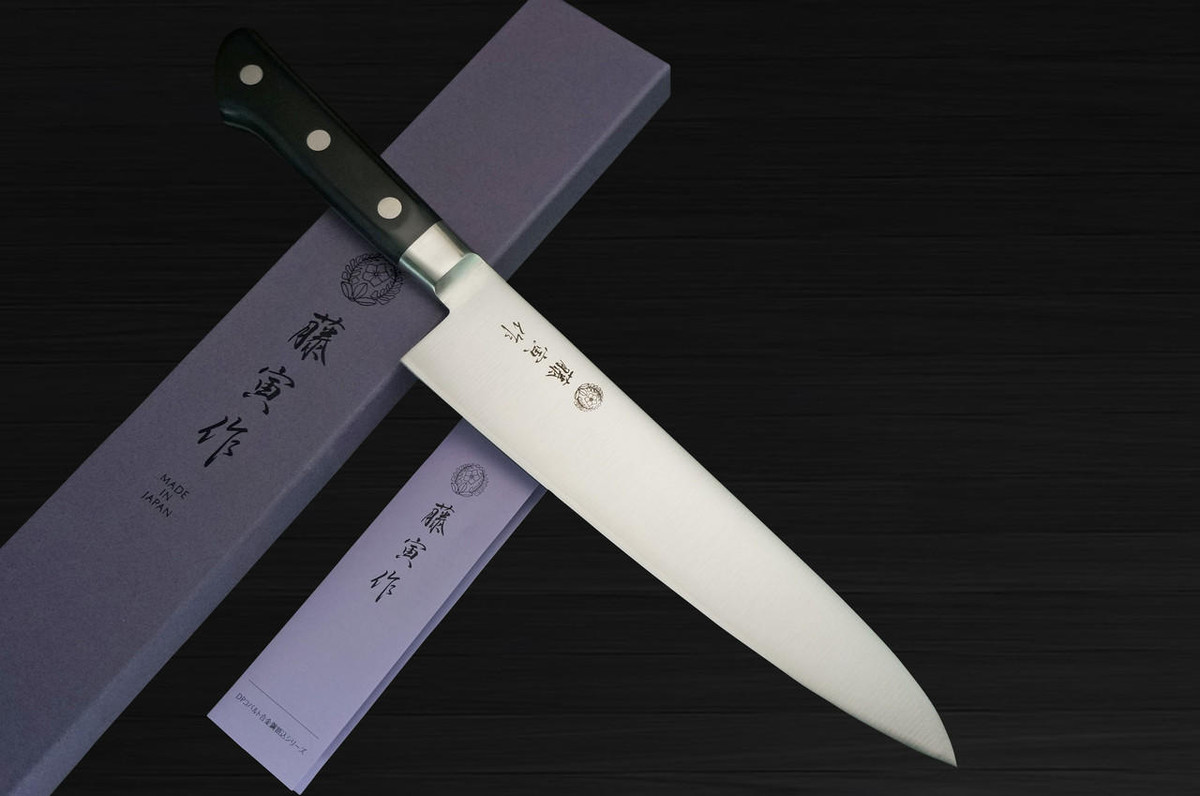
Weight distribution: The full tang adds 30–80g of steel inside the handle, shifting the knife's balance point rearward — toward the hand rather than the blade. Tojiro's technical guide notes that "yo-handle knives have a center of gravity closer to the hand, creating a different balance feel than wa-handle knives where weight concentrates in the blade" (Source: tojiro.net).
Durability: Riveted construction is mechanically robust. The handle cannot loosen or separate from the tang without rivet failure — which essentially never happens in normal use. Wa-handles, by contrast, can loosen over time as the wood dries or absorbs moisture, requiring re-seating.
Waterproofing: Modern yo-handles use stabilized wood, Micarta (resin-impregnated linen), G10 (fiberglass composite), or injection-molded plastic — all essentially waterproof. This makes yo-handles more forgiving for cooks who aren't meticulous about drying the handle after washing.
Replaceability: Wa-handles can be replaced at home in 10 minutes with a new handle and a mallet. Yo-handles require new rivets and sometimes professional fitting. Kenichi Mitsuburo (研匠光三郎) emphasizes this distinction: "wa-handles are designed to be replaced as part of normal knife maintenance — many professional chefs replace their handles every 1–3 years" (Source: mitusaburo.com).
Yo-Handle Materials
Wood (pakka wood, stabilized wood): The most common material on mid-range Western-style knives. Pakka wood is resin-impregnated hardwood — colorful, moisture-resistant, and smooth. Found on popular Japanese brands like Tojiro's DP series.
Micarta: Linen or canvas sheets layered with phenolic resin and compressed. Extremely durable, slightly textured for grip, impervious to moisture. Common on American and European knives; increasingly seen on Japanese yo-handle models.
G10: Fiberglass fabric in epoxy resin. Lighter than Micarta, available in many colors, very grip-secure even when wet. Popular in the custom knife world.
Plastic / polypropylene: Hygienic, dishwasher-safe, cheap. Found on professional-kitchen workhorse knives (Victorinox, Mercer) where handles get abused and need to survive sanitizer baths.
Stainless steel: Full-metal handles on some premium brands. Hygienic but cold, heavy, and slippery when wet unless textured.
Balance and Feel: How the Handle Changes Everything
 Source: Hocho-Knife.com
The Physics of Balance
Here's where the wa-vs-yo debate gets concrete. Take the same blade — say, a 210mm gyuto in VG-10 steel — and fit it with each handle type. The blade weight stays the same. But:
- Wa-handle version: Handle weighs 25–40g (ho wood + buffalo horn ferrule). Total knife weight: ~150–170g. Balance point: 20–40mm forward of the handle junction, well into the blade.
- Yo-handle version: Handle weighs 60–100g (full tang + pakka wood scales + rivets). Total knife weight: ~180–220g. Balance point: near the handle junction or slightly into the handle.
That 15–30mm shift in balance point changes how the knife moves through food:
Forward balance (wa): The blade drops into cuts under its own weight. Less wrist effort for push-cuts. The knife feels nimble and responsive — what Japanese cooks describe as karui (軽い, light). Ideal for the rapid, precise cutting techniques of Japanese cuisine.
Neutral/rear balance (yo): The knife feels planted and stable in the hand. Better for heavy rocking cuts and the sustained downward pressure used in Western butchery and chopping. Provides more control during aggressive techniques.
Grip Styles
The handle choice also aligns with different grip styles:
Pinch grip (つまみ持ち): Thumb and forefinger grip the blade at the heel (choil area), with the remaining fingers wrapping lightly around the handle. This is the dominant professional grip in both Japanese and Western fine dining. Wa-handles excel here because the light handle doesn't fight the pinch — the fingers on the handle are guiding, not gripping.
Handle grip (握り持ち): The entire hand wraps around the handle like a hammer. More common among home cooks and in heavy-duty prep. Yo-handles feel more natural for this grip because the wider profile fills the palm and the riveted construction provides a solid, locked-in feel.
What Japanese Knife Makers Say
Jikko (堺實光)
Jikko's handle guide breaks it down by user: "For the professional chef who spends 8+ hours a day with a knife in hand, the wa-handle's lightness reduces wrist fatigue. For the home cook who uses a knife for 30 minutes a day, the yo-handle's stability and low maintenance may be more practical" (Source: jikko.jp).
Tojiro (藤次郎)
Tojiro manufactures identical blade models in both wa and yo configurations — their DP Cobalt Alloy series is available in both handle types. Their product guide states: "The choice between wa and yo is a matter of personal cutting style. Neither impacts blade performance. We recommend trying both before committing" (Source: tojiro.net).
Takahashi Kusu (高橋楠)
As a Sakai-based handle manufacturer and wholesaler, Takahashi Kusu offers detailed guidance on matching handle shape to knife type: "Round handles for deba, shinogi for yanagiba and usuba, octagonal for gyuto and special knives. But ultimately, the cook's hand must decide" (Source: takahashikusu.co.jp).
Wa-Handle Replacement: A Key Advantage
One of the most underappreciated benefits of wa-handles is replaceability. Over years of professional use, handles wear out — the bore loosens, the wood absorbs oil and food particles, the ferrule cracks. With a wa-handle, replacement takes minutes:
- Tap the old handle off by striking the handle's base against a hard surface (the tang slides out)
- Select a new handle in the desired material and shape
- Heat the tang briefly (optional — helps burn a tight fit)
- Drive the tang into the new handle with a mallet
This means a professional chef can upgrade from a ho-wood handle to an ebony octagonal handle on their existing blade — transforming the knife's character without buying a new one. Mitsuburo (研匠光三郎) provides detailed guides for home handle replacement: "Even non-professionals can replace a wa-handle at home with basic tools" (Source: mitusaburo.com).
Yo-handles, by contrast, are permanently attached. If the handle cracks or deteriorates, the repair involves drilling out old rivets, fitting new scales, and re-riveting — a job most people send to a professional.
How to Choose: A Decision Framework
 Source: Hocho-Knife.com
Choose a Wa-Handle If...
- You use the pinch grip for most cutting tasks
- You prefer lightweight, blade-forward balance
- You practice Japanese cutting techniques (push-cut, pull-cut)
- You enjoy the aesthetics of traditional Japanese knives
- You want the option to upgrade or replace the handle later
- You maintain your knives carefully (drying after washing, occasional oiling)
Choose a Yo-Handle If...
- You use the handle grip or want a knife that feels stable with any grip
- You prefer heavier, center-balanced knives
- You do lots of rocking cuts (Western-style herb mincing, etc.)
- You want a lower-maintenance handle that tolerates more moisture exposure
- You're buying your first Japanese knife and want something that feels familiar
- Dishwasher resistance is important to you (note: we recommend hand-washing all Japanese knives regardless)
The Hybrid Approach
Many Japanese knife buyers own both: wa-handle traditional knives for Japanese cooking and yo-handle gyuto or petty knives for Western techniques. There's no rule that says you have to pick one system. In fact, having both handle styles gives you intuitive cues about which knife to grab — the feel of the handle immediately puts you in the right cutting mindset.
Caring for Each Handle Type
Wa-Handle Care
- Never soak in water. The bore where the tang inserts will absorb water, swell, and eventually crack or rot.
- Dry immediately after washing. Wipe the handle with the same towel you use for the blade.
- Oil periodically: Food-safe mineral oil or camellia oil (tsubaki abura), applied with a cloth, keeps the wood hydrated and prevents cracking in dry climates. Once a month is sufficient for home use.
- Check for looseness: Periodically grip the blade (carefully) and try to wiggle the handle. If it moves, re-seat it by tapping the handle base against a cutting board. If it's severely loose, consider replacing the handle.
- Avoid extreme temperature changes: Don't store wa-handle knives near stove heat or in cold garages. Wood contracts and expands with temperature, which can loosen the fit.
Yo-Handle Care
- Wash by hand even though many yo-handle materials are dishwasher-resistant. Dishwasher detergent is alkaline and damages blade steel even if the handle survives.
- Check rivet tightness: Over years, rivets can develop slight play. If you notice any movement between handle scales and the tang, a knife smith can re-rivet.
- Clean the tang channel: On partial-tang yo-handles, food and moisture can accumulate in the gap between the tang and handle material. Periodically clean this with a thin brush.
- Condition wood handles: If your yo-handle uses real wood (not Micarta or G10), apply mineral oil occasionally to prevent drying.
Price Impact of Handle Choices
Handle selection significantly affects final knife pricing. Here are typical price differences for the same blade:
| Handle Type | Typical Premium Over Base | Example |
|---|---|---|
| Ho wood + plastic ferrule | Base price | ¥0 |
| Ho wood + buffalo horn | +¥2,000–¥5,000 | Professional standard |
| Ebony + buffalo horn | +¥5,000–¥15,000 | Premium professional |
| Rosewood + buffalo horn | +¥4,000–¥12,000 | Collector favorite |
| Octagonal ebony | +¥8,000–¥20,000 | Highest tier |
| Yo-handle (pakka wood) | +¥1,000–¥3,000 vs ho-wood wa | Western style |
| Yo-handle (Micarta/G10) | +¥3,000–¥8,000 vs ho-wood wa | Modern premium |
These premiums are based on catalog comparisons from Ichimonji Mitsuhide and Jikko, where the same blade is offered with multiple handle options.
Frequently Asked Questions
Can I put a wa-handle on a knife that came with a yo-handle?
Not easily. Yo-handle knives have a flat, wide tang designed for riveted construction. Wa-handles require a narrow, pointed tang that fits into a bored hole. Converting from yo to wa would require cutting down the tang — possible but it weakens the knife structurally and voids any warranty. Some custom knife makers offer tang modifications, but it's generally better to buy the handle style you want from the start.
Do left-handed cooks need different handles?
For wa-handles: round and octagonal shapes work equally well for left and right hands. D-shape (shinogi) handles are hand-specific — the flat side is oriented for the dominant hand's grip. Many Japanese knife shops sell left-handed shinogi handles, and Sakai's major manufacturers routinely produce left-hand configurations. For yo-handles: symmetrical shapes work for both hands. Contoured or ergonomic yo-handles may be hand-specific.
How long does a wa-handle last before it needs replacing?
For a professional chef using the knife 8+ hours daily: 1–3 years before the bore loosens significantly, according to Mitsuburo (研匠光三郎). For a home cook: 5–15 years, depending on how often you wash the knife and how dry you keep the handle. Ebony and rosewood handles last significantly longer than ho wood due to their density and water resistance — some professional chefs report 5+ years from premium handles.
Is octagonal (八角) really worth the premium?
Subjective, but here's the case for it: the eight facets provide the most secure grip of any wa-handle shape, the flat surfaces prevent the knife from rolling on the counter, and the angular profile gives your fingers rotational reference without looking at the blade. Suisin (酔心) positions octagonal handles as "the natural choice for serious cooks who want maximum control." Against it: some cooks find the facets create pressure points during extended use. Try before you buy if possible.
What's the best handle for someone with small hands?
For wa-handles, the key dimension is diameter — look for handles in the 22–24mm range rather than the standard 25–27mm. Many Sakai manufacturers offer slim handles on request. Shape-wise, D-shape provides the best control for small hands because the flat surface anchors the grip. For yo-handles, look for narrow profiles and avoid thick, blocky Western handles. The Tojiro DP series and similar Japanese yo-handle lines tend to run slimmer than German equivalents. Compare your options using our maker database.
Related Reading
- Japanese Knife Steel Guide: Shirogami, Aogami, and VG-10 Explained
- How to Sharpen a Japanese Knife with a Whetstone
- Sakai vs. Seki vs. Echizen: Japan's Three Knife-Making Capitals
— The Blade & Steel Team