Nakiri vs. Usuba: Japanese Vegetable Knives Explained
Stand in front of the display case at any knife shop in Sakai, and the nakiri and usuba sit side by side looking nearly identical. Both are rectangular. Both are designed exclusively for vegetables. Both have that distinctive flat-edged profile that separates them from the curved blades of the gyuto and santoku.
Quick Answer
- The nakiri is a double-edged (両刃) vegetable knife designed for home cooks, while the usuba is a single-edged (片刃) professional knife requiring years of training to use properly — they look similar but serve fundamentally different purposes
- Nakiri knives typically run 150–180mm with blade hardness around 57–59 HRC, while professional usuba knives start at 180mm and extend to 240mm for sushi-bar chefs working through mountains of daily prep
- The usuba's single-bevel grind enables techniques the nakiri simply cannot replicate: paper-thin katsuramuki (rotary peeling), decorative kazari-giri cuts, and precision vegetable work that defines high-end Japanese cuisine
- For 95% of home cooks, the nakiri is the right choice — it's easier to sharpen, more forgiving of technique errors, and handles everything from cabbage shredding to daikon prep without the steep learning curve of the usuba
Two Knives That Look Alike but Couldn't Be More Different
 Source: JapaneseChefsKnife.com
Stand in front of the display case at any knife shop in Sakai, and the nakiri and usuba sit side by side looking nearly identical. Both are rectangular. Both are designed exclusively for vegetables. Both have that distinctive flat-edged profile that separates them from the curved blades of the gyuto and santoku.
But pick them up, and the difference hits immediately. The nakiri feels balanced, approachable, familiar. The usuba feels like a specialized instrument — because it is one.
This guide draws on Japanese-language sources from Jikko (堺實光), Ichimonji Mitsuhide (堺一文字光秀), KOHNO, Sakura Japanese Knife, Kitchen Knife Diary (包丁日記), and My Best (マイベスト) to break down what actually separates these two knives, when each one shines, and which one belongs in your kitchen.
What Is a Nakiri?
Name and Purpose
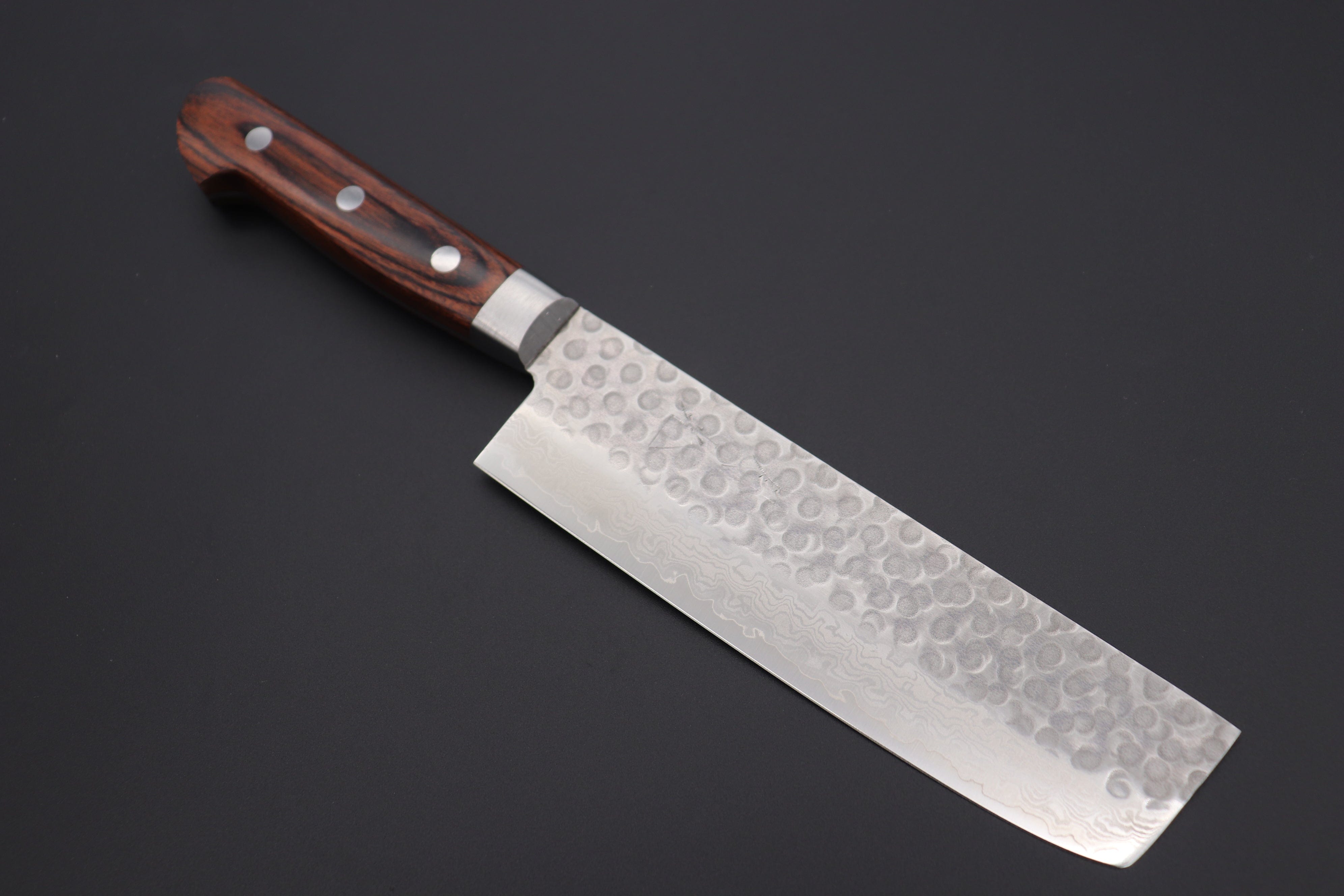
Nakiri bocho (菜切包丁) literally translates to "vegetable-cutting knife." The name says it all. This is a dedicated vegetable knife designed for the home kitchen — one of the oldest knife forms in Japanese domestic cooking, predating the now-ubiquitous santoku by decades.
The nakiri's rectangular blade profile provides maximum contact with the cutting board, making it extraordinarily efficient at the push-cut (oshi-kiri) technique that dominates Japanese home cooking. Jikko (堺實光) describes the nakiri as having "a flat, straight cutting edge that contacts the board uniformly, enabling clean, consistent cuts through vegetables" (Source: jikko.jp, "Nakiri Advantages and Disadvantages").
Physical Characteristics
Blade type: Double-edged (両刃 — ryoba) Blade length: 150–180mm (165mm is the most popular home size according to My Best's 2026 ranking) Blade shape: Rectangular with a flat cutting edge and rounded corners at the spine. The tip is blunt — this is not a knife designed for piercing or detail tip work. Blade height: Wide — typically 45–50mm from spine to edge, providing excellent knuckle clearance Weight: 130–200g depending on materials Hardness: Stainless models typically achieve 57–59 HRC; carbon steel models reach 60–63 HRC
What the Nakiri Does Best
The nakiri excels at the tasks that make up 80% of Japanese vegetable prep:
- Shredding cabbage (kyabetsu no sengiri): The flat edge and wide blade make ultra-thin cabbage shredding effortless. According to KOHNO, the nakiri's uniform blade contact produces "noticeably more even shreds than a santoku or gyuto" (Source: kohno-onlineshop.com)
- Dicing onions and root vegetables: The blade's height gives you clearance for your knuckles while maintaining control through dense, hard vegetables like gobo (burdock root) and kabocha
- Julienne cuts: Carrots, daikon, cucumber — the flat edge profile keeps every strand uniform
- Mincing herbs and aromatics: Shiso, mitsuba, green onions — quick up-and-down chopping with full board contact
Cutting Technique
The nakiri is built for the push-cut (oshi-kiri). Place the blade on the vegetable, press forward and down in a single motion. The entire edge contacts the board simultaneously, producing a clean separation without the tearing or crushing that can happen with curved blades.
Because the blade is double-edged, it cuts straight down through the food without the lateral deflection that single-bevel knives produce. This means even a complete beginner can make reasonably straight cuts on the first try. Ichimonji Mitsuhide notes that the nakiri is "recommended for anyone who wants to improve their vegetable cutting without specialized training" (Source: ichimonji.co.jp).
What Is an Usuba?
Name and Purpose
Usuba bocho (薄刃包丁) translates to "thin-blade knife." Despite the similar rectangular shape, the usuba occupies an entirely different category in Japanese knife culture. It is a professional-grade, single-bevel knife — one of the three core knives (sanbon no hocho) that every trained Japanese chef owns alongside the yanagiba (sashimi knife) and deba (fish knife).
The usuba exists for a singular purpose: to achieve the level of vegetable cutting precision demanded by traditional Japanese cuisine (washoku). The kind of work that turns a block of daikon into a translucent sheet, or transforms a carrot into an intricate flower. This is not a home cooking tool. This is a chef's instrument.
Physical Characteristics
Blade type: Single-edged (片刃 — kataba) Blade length: 180–240mm (professional standard is 210mm, according to Ichimonji Mitsuhide) Blade shape: Rectangular, but with key regional variations (see below). The single bevel creates a flat front face (shinogi-men) and a concave back (ura). Blade height: Similar to nakiri, but the single-bevel grind changes how that height functions Weight: 200–350g — heavier than nakiri due to thicker spine and longer blade Hardness: Typically 60–65 HRC in carbon steel (white steel or blue steel)
Regional Variations: Kanto vs. Kansai
One of the most distinctive features of the usuba is its regional split:
Edo usuba (東型薄刃 — Kanto/Tokyo style): Squared-off tip with right angles at both corners. The blade profile is a near-perfect rectangle. This is the style associated with Tokyo's sushi culture and Kanto-region professional kitchens. Kitchen Knife Diary describes the Edo usuba as having "corners rounded slightly for safety but maintaining an essentially rectangular profile" (Source: kitchen-knife-diary.net).
Kamagata usuba (鎌形薄刃 — Kansai/Osaka style): The spine curves gently downward toward the tip, creating a pointed end resembling a sickle (kama). This Kansai variant gives the chef a pointed tip for detail work and decorative cutting — an advantage the blunt-tipped Edo version lacks. The kamagata usuba is the dominant style in Osaka, Kyoto, and throughout the Kansai region.
What the Usuba Does That No Other Knife Can
The usuba's single-bevel construction isn't just a design choice — it enables techniques that are physically impossible with a double-edged knife:
Katsuramuki (桂剥き): The signature usuba technique. Holding a cylinder of daikon or cucumber against the blade, the chef rotates the vegetable while drawing the knife to peel off a continuous, paper-thin sheet. Professional chefs can produce sheets as thin as 1mm that are translucent when held to light. This technique requires a perfectly flat front face — something only a single-bevel knife provides. According to KOHNO, "katsuramuki is considered one of the fundamental skills that separates professional Japanese cooks from home cooks, and the usuba is the only knife designed for it" (Source: kohno-onlineshop.com).
Kazari-giri (飾り切り): Decorative vegetable cutting — turning cucumbers into fans, carrots into plum blossoms (umebachi), daikon into chrysanthemums (kikka daikon). These ornamental cuts appear in kaiseki (traditional multi-course Japanese dining) and require the usuba's razor-thin single bevel to execute cleanly.
Precision thin-cutting: The single bevel's asymmetric grind means one side of the blade is perfectly flat. When cutting, the flat side rides along the food's surface, producing cuts of exactly the thickness the chef intends. Double-edged knives push food away from both sides simultaneously, making ultra-thin precision cuts significantly harder.
Head-to-Head Comparison
| Feature | Nakiri (菜切) | Usuba (薄刃) |
|---|---|---|
| Blade type | Double-edged (両刃) | Single-edged (片刃) |
| Target user | Home cooks | Professional chefs |
| Typical length | 150–180mm | 180–240mm |
| Weight range | 130–200g | 200–350g |
| Typical hardness | 57–63 HRC | 60–65 HRC |
| Katsuramuki capable | No | Yes |
| Decorative cutting | Limited | Full capability |
| Ease of sharpening | Easy (both sides evenly) | Difficult (asymmetric geometry) |
| Learning curve | Low | Very high |
| Forgiveness of technique errors | High | Low — chips and poor cuts from bad angle |
| Regional variations | None | Edo (Kanto) vs. Kamagata (Kansai) |
| Price range | ¥3,000–¥30,000 | ¥10,000–¥100,000+ |
| Steel types | Stainless, carbon, Damascus | Predominantly carbon (white/blue steel) |
The Steel Behind Each Knife
Nakiri: Accessible Range of Materials
Because the nakiri is a home kitchen knife, it's available across the full spectrum of Japanese knife steels:
- Stainless steel (VG-10, Molybdenum-Vanadium, AUS-8): The most popular choice for home users. Rust-resistant, easy to maintain, suitable for dishwasher-averse households. Check our steel comparison guide for detailed breakdowns.
- Carbon steel (White Steel #2, Blue Steel #2): Better cutting feel and easier sharpening, but requires immediate drying after use to prevent rust. Popular among cooking enthusiasts who enjoy the ritual of knife maintenance.
- Damascus clad: A carbon or high-performance stainless core with softer stainless steel layers on each side, creating the distinctive wavy pattern. Provides cutting performance with some corrosion protection on the flat surfaces.
The My Best 2026 nakiri ranking found that stainless models dominate the top 10, with VG-10 and Molybdenum steel variants earning the highest overall scores for home use (Source: my-best.com, "Nakiri Bocho Osusume Ranking 2026").
Usuba: Carbon Steel Is King
Professional usuba knives are almost exclusively made from carbon steel — specifically:
- White Steel #1 and #2 (shirogami): The purist's choice. Extremely sharp, relatively easy to sharpen, but reactive (rusts quickly). White #1 achieves higher hardness (up to 65 HRC) but is more brittle.
- Blue Steel #1 and #2 (aogami): Adds tungsten and chromium to the white steel formula for improved edge retention and slight rust resistance. Blue #2 is the most popular professional usuba steel according to Ichimonji Mitsuhide's product recommendations.
- Blue Super (aogami super): The performance apex of carbon steel — highest edge retention, but demanding to sharpen correctly.
Why no stainless usuba? A few exist, but the professional market overwhelmingly rejects them. The reason is sharpening geometry. Single-bevel knives require maintaining a perfectly flat front face, and carbon steel responds to whetstone work more predictably than stainless. Jikko notes that "for professional-grade single-bevel knives, carbon steel remains the standard because it allows the craftsman to achieve the precise geometry required" (Source: jikko.jp).
How Japanese Knife Experts Recommend Choosing
Choose the Nakiri If...
- You're a home cook looking to upgrade your vegetable prep
- You want something more specialized than a santoku but don't need professional-level precision
- You cook Japanese home meals that involve lots of chopping: miso soup (misoshiru), stir-fries (itame-mono), salads, pickles (tsukemono)
- You prefer low-maintenance stainless steel
- Your knife budget is under ¥15,000
- You want a knife you can sharpen on a whetstone without professional training
KAI (貝印), Japan's largest knife manufacturer, explicitly positions the nakiri as the "vegetable specialist for the home kitchen" and recommends it alongside a santoku as a two-knife foundation for home cooks (Source: kai-group.com).
Choose the Usuba If...
- You are a professional chef or serious cooking student
- You want to master katsuramuki and decorative cutting techniques
- You already own and maintain carbon steel knives comfortably
- You understand single-bevel sharpening or have access to a professional sharpener
- Your work demands the precision of traditional washoku presentation
- You're ready to invest ¥20,000–¥100,000+ in a knife that requires daily maintenance
The "Both" Option
Some advanced home cooks own a nakiri for daily vegetable prep and an entry-level usuba for practicing katsuramuki and decorative cuts. This two-knife vegetable setup mirrors the professional approach of having both a daily workhorse and a precision instrument.
Size Guide: What Length to Buy
Nakiri Sizing
| Size | Best For | Notes |
|---|---|---|
| 150mm | Small hands, compact kitchens, light prep | Agile but limited capacity for large vegetables |
| 165mm | Most popular all-around home size | The sweet spot recommended by My Best and KOHNO |
| 180mm | Larger hands, serious home cooks | More blade surface but heavier; requires more board space |
Usuba Sizing
| Size | Best For | Notes |
|---|---|---|
| 180mm | Entry-level professional, home enthusiast | Manageable length for learning single-bevel technique |
| 195mm | Small-handed professional chefs | Common for women in professional Japanese kitchens |
| 210mm | Standard professional length | The default for trained chefs, per Ichimonji Mitsuhide |
| 225–240mm | High-volume professional prep | For chefs doing extensive katsuramuki on large daikon |
Maintenance Differences
 Source: JapaneseChefsKnife.com
Nakiri Maintenance
If you own a stainless nakiri, maintenance is straightforward:
- Wash with mild dish soap immediately after use
- Dry thoroughly with a clean cloth — never air-dry in a rack
- Sharpen on a #1000 medium whetstone every 2–4 weeks, followed by a #3000–#6000 finishing stone
- Store on a magnetic strip, in a blade guard, or in a knife block
For carbon steel nakiri, add: wipe the blade during use when cutting acidic foods (tomatoes, citrus), and apply a thin coat of camellia oil (tsubaki abura) before storage.
Usuba Maintenance
Usuba maintenance is significantly more demanding:
- Wash and dry immediately — carbon steel usuba knives rust within minutes if left wet
- Sharpen regularly on whetstones, maintaining the single-bevel geometry. The front face (omote) is sharpened at approximately 10–15 degrees; the back face (ura) is flattened with light, careful strokes to maintain its concavity
- Never use a pull-through sharpener or electric sharpener — these destroy single-bevel geometry
- Store wrapped in a blade guard or saya (wooden sheath), with camellia oil applied to the blade
- Inspect the ura (back face) regularly — if the concave hollow wears flat, the knife needs professional re-grinding
Ichimonji Mitsuhide warns that "improper sharpening of a single-bevel knife can permanently damage the blade geometry. If you're uncertain, bring it to a professional" (Source: ichimonji.co.jp).
Common Mistakes to Avoid
With the Nakiri
- Using it on bones or frozen food: The thin blade will chip. Use a deba for bones and thaw frozen items first.
- Rocking the blade: The nakiri's flat profile is designed for push-cuts, not rocking. Rocking lifts the middle of the blade off the board, producing uneven cuts.
- Neglecting the tip corners: The nakiri's squared-off corners are thin and vulnerable. Don't drop the knife or let it clang against other utensils in a drawer.
With the Usuba
- Treating it like a nakiri: The single bevel cuts differently. Food deflects slightly away from the flat face — you must adjust your cutting angle accordingly.
- Cutting hard vegetables straight down: Unlike the nakiri, the usuba's thin edge can chip on dense root vegetables if you use excessive force. Let the blade's sharpness do the work.
- Sharpening the back face too aggressively: The ura should remain concave. Over-sharpening the back converts it to a flat surface, destroying the knife's intended geometry.
- Storing it wet for even a few minutes: Carbon steel usuba knives develop rust spots within 5–10 minutes of exposure to moisture.
Price Ranges and What to Expect
Nakiri Price Tiers
| Tier | Price Range | What You Get |
|---|---|---|
| Entry | ¥3,000–¥8,000 | Stainless steel (Mol-V or AUS-8), plastic handle, machine-ground |
| Mid-range | ¥8,000–¥20,000 | VG-10 or carbon steel, wa-handle (wooden Japanese handle), hand-finished |
| Premium | ¥20,000–¥50,000 | Aogami Super or Damascus-clad, artisan-forged in Sakai, Seki, or Echizen, custom handle |
Usuba Price Tiers
| Tier | Price Range | What You Get |
|---|---|---|
| Entry professional | ¥10,000–¥25,000 | White Steel #2, ho-wood handle, machine-assisted |
| Mid professional | ¥25,000–¥50,000 | Blue Steel #2, water buffalo ferrule, hand-forged, Sakai origin |
| High professional | ¥50,000–¥100,000+ | Blue Super or White #1, ebony or rosewood handle, master craftsman |
| Heirloom/collector | ¥100,000–¥300,000+ | Honyaki (mono-steel), named master smith, museum-grade finish |
What About the Chinese Cleaver Comparison?
Japanese sources frequently note that Western audiences confuse the nakiri with the Chinese cleaver (chukabocho, 中華包丁). While both are rectangular, they're completely different tools:
- The Chinese cleaver is heavy (300–800g) and uses weight to power through ingredients; the nakiri is light (130–200g) and relies on blade geometry
- The Chinese cleaver handles bones and joints through its weight; the nakiri's thin blade would chip on bone
- The Chinese cleaver is a multi-purpose tool (cutting, crushing garlic, scooping); the nakiri is a specialist for vegetable cutting only
Sakura Japanese Knife describes this as "one of the most common misunderstandings among Western knife buyers — the nakiri and Chinese cleaver share a silhouette but share almost nothing in design philosophy or use" (Source: media.sakurajapaneseknife.com).
Frequently Asked Questions
Can I use a nakiri as my only knife?
Not comfortably. The nakiri is a vegetable specialist — it's not designed for breaking down proteins, slicing sashimi, or handling bones. For a one-knife kitchen, stick with a santoku or gyuto. The nakiri works best as a second or third knife alongside a general-purpose blade. KOHNO recommends the nakiri as "an excellent addition to a santoku-based kitchen" rather than a standalone choice (Source: kohno-onlineshop.com).
Is an usuba worth buying for home use?
Only if you're genuinely committed to learning katsuramuki and decorative cutting — and willing to maintain a carbon steel single-bevel knife. For most home cooks, the usuba will sit unused because its techniques require significant practice. A nakiri covers 95% of home vegetable prep more accessibly. That said, home cooking enthusiasts who treat knife skills as a hobby find the usuba deeply rewarding.
Why are usuba knives so much more expensive than nakiri knives?
Three factors: material, construction, and skill. Usuba knives use premium carbon steel (White #1, Blue Super) that costs more as raw material. Single-bevel construction requires more skilled grinding — the flat face must be perfectly straight across the entire blade length, which demands hand-finishing by experienced craftsmen. And the market is smaller (professionals only), so production volumes are lower. A hand-forged Sakai usuba from a named smith involves roughly 3x the labor of a machine-assisted nakiri.
What's the difference between an Edo usuba and a kamagata usuba?
Shape at the tip. The Edo (Kanto/Tokyo) usuba has a rectangular, squared-off tip — functionally blunt. The kamagata (Kansai/Osaka) usuba has a curved spine that tapers to a point, giving the chef a working tip for detail cuts. Modern professional preference has shifted toward the kamagata, as its pointed tip adds versatility without sacrificing the flat-edge performance of the Edo style. Kitchen Knife Diary notes that "even in Tokyo, younger chefs increasingly choose the kamagata for its additional tip functionality" (Source: kitchen-knife-diary.net).
How often should I sharpen each knife?
For a nakiri used daily in a home kitchen: every 2–4 weeks on a #1000 whetstone, with a #3000+ finishing stone. For an usuba in professional use: daily touch-ups on a finishing stone (#3000–#6000) before service, with a full sharpening session on a #1000 stone weekly. The usuba's harder steel and more acute edge angle mean it maintains sharpness well but demands precise, regular maintenance to keep the single-bevel geometry intact. See our complete whetstone guide for technique details.
Related Reading
- Gyuto vs. Santoku: What Japanese Home Cooks Actually Use
- Japanese Knife Steel Guide: Shirogami, Aogami, and VG-10 Explained
- Sakai vs. Seki vs. Echizen: Japan's Three Knife-Making Capitals
— The Blade & Steel Team