Japanese Kitchen Knife Buying Guide: What to Know Before Your First Purchase
Here's the thing most buying guides won't tell you: your first Japanese knife will either convert you into a lifelong knife enthusiast or convince you that the whole "Japanese knife" thing is overhyped. The difference comes down to whether you bought the right knife for your actual cooking style — or whether you got distracted by Damascus patterns and YouTube recommendations.
Quick Answer
- Start with a santoku (三徳包丁) if you cook mostly Japanese or vegetable-heavy dishes, or a gyuto (牛刀) if you cook Western-style meat and fish dishes — both cost ¥3,000–¥8,000 for a quality starter blade
- Choose stainless steel (ステンレス) for your first knife — it resists rust, requires less maintenance, and forgives the kind of neglect that destroys carbon steel. Upgrade to carbon when your sharpening skills catch up
- The three factors that matter most for first-time buyers are blade length (165–180mm for home use), steel type (stainless vs. carbon), and handle style (Western *yo* handles feel familiar; Japanese *wa* handles are lighter)
- Buy from a knife specialty shop (*hamono-ten*) or a reputable online retailer like Kakaku.com rather than a home center — even at the same price point, specialty retailers stock better-constructed knives and offer sharpening advice
Why Your First Japanese Knife Matters More Than You Think
 Source: Hocho-Knife.com
Here's the thing most buying guides won't tell you: your first Japanese knife will either convert you into a lifelong knife enthusiast or convince you that the whole "Japanese knife" thing is overhyped. The difference comes down to whether you bought the right knife for your actual cooking style — or whether you got distracted by Damascus patterns and YouTube recommendations.
Japanese knives are genuinely superior cutting instruments. That's not marketing. The combination of harder steel (typically HRC 58–63 vs. HRC 54–56 for German knives), more acute edge angles (15 degrees vs. 20–22 degrees), and thinner blade profiles means a Japanese knife slices through food with less effort, less cell damage, and more precision than a Western equivalent.
But Japanese knives are also less forgiving. They chip if you twist them. They rust if you leave them wet. They require whetstone sharpening — pull-through sharpeners and honing steels won't cut it. And the enormous variety of blade types, steels, and handle options can paralyze a first-time buyer.
This guide eliminates the paralysis. We'll walk through every decision point — blade type, steel, handle, size, budget — in the order that matters, using pricing and recommendations sourced entirely from Japanese-language retail sites, manufacturer guides, and knife specialty shops.
Step 1: Choose Your Blade Type
The Two Universal Choices
For your first Japanese knife, you're choosing between two blade types. Everything else — the deba, yanagiba, nakiri, usuba, petty — comes later.
Santoku (三徳包丁) — "Three Virtues"
The santoku is Japan's answer to the question "what if we designed one knife that handles meat, fish, and vegetables equally well?" The name literally means "three virtues" (san-toku), referring to its ability across all three food categories.
Key characteristics:
- Blade length: 160–180mm (most common: 165mm or 170mm)
- Blade profile: Relatively flat, with a gentle curve near the tip
- Cutting motion: Push-cut (oshi-kiri) — the blade moves straight down, not rocking
- Weight: 110–170g depending on construction
- Edge type: Double-bevel (both sides sharpened equally)
The santoku is the default recommendation for first-time buyers from virtually every Japanese knife retailer and manufacturer. Matsui Hamono, a specialty knife shop, states directly: "For beginners or those not accustomed to using knives, we recommend the santoku" (Source: matsui-hamono.com, "料理初心者におすすめの包丁").
Tojiro's buying guide agrees: "The kinds of knives used differently based on ingredients and cooking methods — among them, the 'santoku,' 'gyuto,' and 'petty' are the first to get. Starting from here" (Source: tojiro.net, "包丁の種類と使い分け").
Gyuto (牛刀) — "Beef Sword"
The gyuto is Japan's adaptation of the French chef's knife. Despite the name ("beef sword"), it's a general-purpose knife that handles all ingredients. Its curved blade profile and pointed tip support both push-cutting and rocking motions.
Key characteristics:
- Blade length: 180–210mm for home use (professionals go up to 270–300mm)
- Blade profile: Continuous curve from heel to tip, more pronounced than santoku
- Cutting motion: Both push-cut and rock-cut (rocking), plus slicing
- Weight: 130–200g depending on size and construction
- Edge type: Double-bevel
The gyuto is the better choice if you regularly cook Western-style dishes, work with large cuts of meat, or prefer the rocking-cut motion for mincing herbs and garlic.
For a detailed comparison between these two options, including cutting technique analysis and price breakdowns, see our santoku vs. gyuto comparison.
Decision Matrix: Santoku or Gyuto?
| If you... | Choose |
|---|---|
| Cook mostly Japanese dishes | Santoku |
| Cook mostly Western dishes | Gyuto |
| Cook a mix of both | Either works — lean santoku for smaller kitchens |
| Are a complete beginner | Santoku (shorter, lighter, less intimidating) |
| Work with large vegetables and meat | Gyuto (longer blade, more versatile tip) |
| Have a small kitchen or cutting board | Santoku (compact, 165–170mm is very manageable) |
| Plan to add more knives later | Gyuto first, then add a nakiri for vegetables |
Step 2: Choose Your Steel
This is where most guides drown you in metallurgy. We'll keep it simple. For your first knife, you're choosing between two categories.
Stainless Steel (ステンレス鋼) — Recommended for Beginners
Stainless steel kitchen knives contain chromium (typically 13%+) that forms an invisible oxide layer on the blade surface, preventing rust. They're not literally "stainless" — they can discolor and even rust with extreme neglect — but they forgive the kind of treatment that would destroy a carbon steel blade in hours.
Common stainless steels in Japanese knives, ordered by quality:
| Steel | Hardness (HRC) | Characteristics | Price Tier |
|---|---|---|---|
| MoV (モリブデン・バナジウム) | 56–58 | Basic stainless, adequate edge retention, very rust-resistant | Budget (¥1,500–¥3,000) |
| AUS-8 | 57–59 | Good all-rounder, easy to sharpen, decent edge retention | Mid (¥3,000–¥5,000) |
| VG-10 (V Gold 10) | 58–61 | Cobalt-enhanced, excellent edge retention, good corrosion resistance | Mid-premium (¥4,000–¥10,000) |
| VG-1 | 58–60 | Similar to VG-10 without cobalt, slightly easier to sharpen | Mid (¥3,000–¥7,000) |
| Ginsan (#3 Silver Steel) | 59–61 | Closest stainless equivalent to carbon steel in edge feel | Premium (¥8,000–¥20,000) |
For your first knife, VG-10 or MoV stainless is the sweet spot. VG-10 gives you genuinely impressive edge retention in a rust-resistant package. MoV is the budget-friendly alternative that still outperforms any German stainless.
Kai Group — Japan's largest knife manufacturer — specifically recommends stainless steel for beginners on their official buying guide: they highlight that the advantages of carbon steel (鋼/hagane) include "extremely good sharpness" and "easy to sharpen, affordable price range," but the disadvantages include "easy to chip and very prone to rust, requiring frequent maintenance." Their recommendation: stainless for home cooks who want low maintenance (Source: kai-group.com, "包丁の選び方のポイント").
Carbon Steel (鋼 / ハガネ) — For When You're Ready
Carbon steel knives are the traditional choice for Japanese cooking. They take a sharper edge, are easier to sharpen on a whetstone, and develop a patina (kashoku) over time that gives each knife a unique character. But they rust aggressively if left wet, require immediate drying after every use, and need periodic oiling with camellia oil (tsubaki abura) for storage.
Common carbon steels in Japanese knives:
| Steel | Hardness (HRC) | Characteristics | Price Tier |
|---|---|---|---|
| SK steel (SK鋼) | 58–60 | Basic carbon, found in budget knives | Budget (¥1,000–¥3,000) |
| Shirogami #2 (白紙二号) | 60–63 | Pure carbon, razor-sharp edge, easy to sharpen | Mid-premium (¥6,000–¥15,000) |
| Shirogami #1 (白紙一号) | 62–65 | Higher carbon than #2, holds edge longer, more brittle | Premium (¥10,000–¥25,000) |
| Aogami #2 (青紙二号) | 62–64 | Chromium + tungsten added, better edge retention | Premium (¥10,000–¥25,000) |
| Aogami Super (青紙スーパー) | 64–67 | Maximum edge retention, most difficult to sharpen | Ultra-premium (¥15,000–¥40,000) |
We don't recommend carbon steel for your first Japanese knife. Not because it's bad — it's objectively better for cutting performance — but because the maintenance burden will frustrate you before you've developed the habits (immediate washing, careful drying, regular sharpening) that carbon steel demands.
For a complete deep-dive into these steels, see our Japanese knife steel guide.
Step 3: Choose Your Handle
Japanese knives come with two handle styles, and the choice affects weight, balance, grip comfort, and maintenance.
Western Handle (Yo Handle / 洋柄)
A riveted handle made from pakkawood, resin, micarta, or stainless steel. It surrounds a tang (extension of the blade) and is secured with metal rivets. This is the handle style on every Wusthof, Henckels, and Global knife you've ever seen.
Pros: Familiar grip, heavier (some prefer the weight for rocking cuts), typically more durable, dishwasher-tolerant (though we still recommend hand-washing)
Cons: Heavier, can feel unbalanced on lighter blades, rivets can loosen over decades
Japanese Handle (Wa Handle / 和柄)
A lightweight handle made from magnolia wood (ho no ki), cherry (sakura), chestnut (kuri), or burned chestnut (yaki-kuri), typically with a buffalo horn or plastic ferrule where the blade meets the handle. The tang is inserted into the handle and press-fit — no rivets.
Pros: Significantly lighter (the blade becomes the dominant weight, improving control), natural wood feel, replaceable (you can install a new handle when the old one wears out)
Cons: Requires more care (don't soak in water), can loosen over time (reinserted by tapping the handle base on a hard surface), less familiar to Western cooks
For your first knife: If you've never used a Japanese knife before, a yo handle minimizes the learning curve. You can always try wa handles on your second or third knife. Our handle comparison guide covers this in much more detail.
Step 4: Choose Your Size
 Source: Hocho-Knife.com
Santoku Sizing
The standard santoku sizes in Japan are:
- 150mm: Compact — good for petite hands, small cutting boards, or as a secondary knife
- 165mm: The most popular size in Japan for home use. Short enough to be nimble, long enough for most tasks
- 170mm: Slightly longer, still very manageable. Many manufacturers default to this size
- 180mm: The upper end for santoku — feels like a small gyuto at this length
Recommendation: 165mm or 170mm. This is the consensus across Japanese knife shops, manufacturer guides, and review sites.
Gyuto Sizing
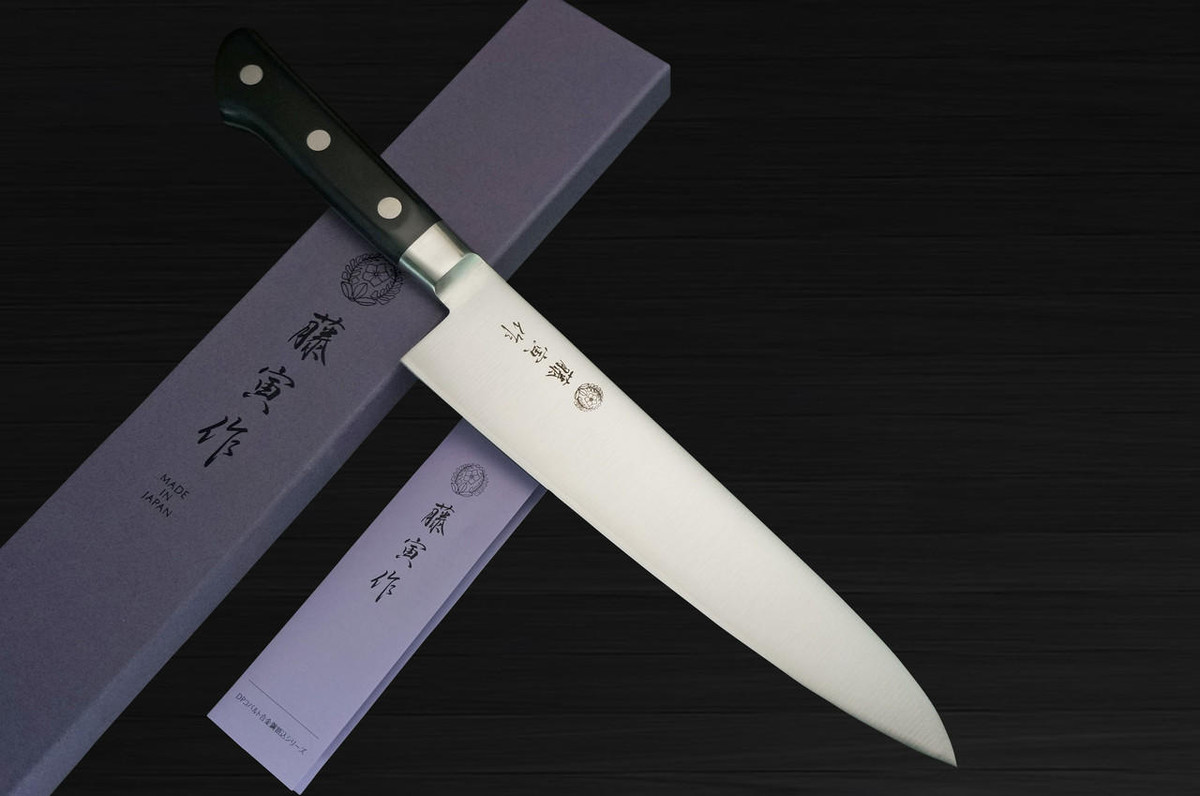
- 180mm: The recommended home-use size. Compact enough for Japanese kitchens, long enough for serious cooking. Tojiro and Kai both produce their most popular gyuto models at this length.
- 210mm: The professional standard in Western kitchens. More versatile than 180mm but requires a larger cutting board and more counter space.
- 240mm: Professional-only in most contexts. Too long for typical home kitchens.
Recommendation: 180mm for your first gyuto. Move to 210mm when you're confident with the knife and have a large enough workspace (Source: tojiro.net, "包丁の選び方"; jikko.jp, "包丁のサイズの選び方").
Step 5: Set Your Budget
The Four Price Tiers (Japanese Domestic Market)
Tier 1: Entry (¥1,500–¥3,000) You get a functional knife with MoV stainless steel, a basic handle, and factory-sharp edge. These knives cut well out of the box and serve adequately for light home cooking. They dull faster than higher-tier knives and may not hold their edge through a full week of daily cooking.
Examples: Kai Seki Magoroku Wakatake (¥1,500), Tojiro Economy (¥1,800)
Tier 2: Mid-Range (¥3,000–¥8,000) — The Sweet Spot This is where value maximizes. You get meaningfully better steel (VG-10 or equivalent), better heat treatment, and a nicer handle. A ¥5,000 knife from this tier outperforms a ¥15,000 German knife in cutting tests. The jump in quality from Tier 1 to Tier 2 is dramatic.
Examples: Tojiro DP series (¥4,400–¥5,500), Kai Seki Magoroku Benifuji (¥3,345), Kai Seki Magoroku Aofuji (¥4,336)
Tier 3: Premium (¥8,000–¥15,000) Damascus cladding, premium handle materials (stabilized wood, micarta), hand-finished edges. You're paying for fit-and-finish and aesthetics as much as cutting performance. The actual cutting difference vs. Tier 2 is marginal.
Examples: Kai Seki Magoroku Damascus (¥10,000–¥12,000), Tojiro Flash (¥14,300), Tadafusa Basic 3 (¥9,350/knife)
Tier 4: Artisan (¥15,000–¥50,000+) Hand-forged by named craftsmen, often in Sakai or Echizen. Carbon steel cores, natural whetstone finishes, custom handles. These are lifetime tools for serious cooks.
Examples: Sakai Takayuki artisan lines, Echizen-forged pieces
Our recommendation: Spend ¥4,000–¥6,000 on your first knife. This puts you firmly in Tier 2, where the performance-per-yen ratio peaks. The Tojiro DP santoku (¥4,400) or gyuto (¥5,500) is the benchmark at this price point.
For specific product recommendations at each price tier, see our Kakaku.com rankings guide.
Step 6: Where to Buy in Japan
Physical Stores
Knife specialty shops (hamono senmon-ten) The best option for first-time buyers. Staff can let you hold multiple knives, recommend models based on your cooking style, and teach basic sharpening technique on the spot. Major cities have them: Doguyasuji (道具屋筋) in Osaka's Namba district is a famous knife shopping street, and Kappabashi (合羽橋) in Tokyo is the kitchen equipment district.
Department stores (hyakkaten) Major department stores (Takashimaya, Mitsukoshi, Isetan) stock curated knife selections in their kitchen floors. Prices are retail (no discounts), but you get guaranteed authenticity and good after-sales service, including sharpening.
Home centers (homu senta) Stores like Cainz, Komeri, and Nafco stock budget to mid-range knives. Selection is limited and staff knowledge varies. Fine for Tier 1 purchases but not the best environment for choosing a serious knife.
Online Retailers
Kakaku.com (価格.com) Japan's leading price comparison site. Essential for checking the lowest available price on any specific model before buying. The site aggregates prices from hundreds of retailers and includes user reviews and ratings. We covered their top-ranked knives in our Kakaku.com rankings guide.
Amazon.co.jp Wide selection, fast shipping, Prime-eligible. Be cautious with third-party sellers — stick to items sold by Amazon or authorized dealer storefronts. Counterfeits exist in the knife space, especially for popular brands like Kai and Tojiro.
Manufacturer direct shops Tojiro (tojiro.net/shop), Tadafusa (tadafusa.net), and Kai (kai-group.com) all operate official online stores. Prices match retail but you get guaranteed authenticity.
My Best (my-best.com) Japan's equivalent of Wirecutter. Their knife rankings are based on standardized testing — they measure cutting force, edge retention, handle comfort, and overall usability across dozens of knives in each category. Their 2026 rankings tested and compared knives across all major Japanese manufacturers (Source: my-best.com, "包丁のおすすめ人気ランキング").
Step 7: Essential Accessories for Your First Knife
Whetstone (砥石) — Non-Negotiable
Japanese knives must be sharpened on a whetstone. Pull-through sharpeners remove too much metal and can't maintain the acute edge angles that Japanese knives depend on. Honing steels (the long metal rods that come with German knife sets) can chip a Japanese blade — the steel is too hard and too brittle for that kind of lateral stress.
Your first whetstone: A combination stone with #1000 grit on one side and #3000 grit on the other. The #1000 side does the actual sharpening; the #3000 side polishes the edge and refines it. Price: ¥2,000–¥4,000 for a quality combination stone.
Popular choices: King KW-65 (#1000/#6000 combination, approximately ¥2,500), Shapton Kuromaku #1000 (approximately ¥2,500 for a single-grit stone).
For step-by-step sharpening instructions, see our whetstone sharpening guide.
Cutting Board
Use wood or soft plastic (polyethylene). Never glass, ceramic, marble, or metal — these surfaces will destroy your edge immediately. End-grain wood boards (kiri no ki or hinoki cypress) are traditional in Japanese kitchens and gentle on blade edges.
Blade Guard or Magnetic Strip
Don't throw your knife loose in a drawer. The edge will contact other utensils and dull within days. Options: a plastic blade guard (saya), a magnetic wall strip, or a knife block. The saya is cheapest (¥300–¥500) and works perfectly.
Common Mistakes First-Time Buyers Make
 Source: Hocho-Knife.com
Source: Pixabay - Free license
Source: Hocho-Knife.com
Source: Pixabay - Free license
Mistake 1: Buying Too Many Knives at Once
You don't need a 12-piece set. You need one good knife. Cook with it daily for 3–6 months. Learn to sharpen it. Understand what tasks it handles easily and where it struggles. Then add a second knife that fills the gap. For most home cooks, a santoku or gyuto plus a small petty knife (120–150mm) covers 95% of kitchen tasks.
Mistake 2: Choosing Carbon Steel Before Learning to Sharpen
Carbon steel rewards skilled users with the sharpest possible edges. But it punishes neglect with aggressive rust — orange spots appearing within hours of leaving the blade wet. Master your sharpening technique on a forgiving stainless blade first. When you can maintain a consistent edge angle and identify when your knife needs sharpening by feel, then explore carbon steel. That guide is in our knife care and rust prevention article.
Mistake 3: Prioritizing Steel Over Ergonomics
A VG-10 blade that doesn't fit your hand is worse than an MoV blade that does. If possible, hold the knife before buying. Check that the handle shape works for your grip style, the blade length suits your cutting board, and the weight feels balanced (not handle-heavy or blade-heavy).
Tojiro's buying guide makes this point clearly: "Choose a knife where the handle fits your hand. Actually grip the handle, swing it around, and select the knife that feels right" (Source: tojiro.net, "包丁の選び方").
Mistake 4: Using a Dishwasher
Never. The combination of high heat, harsh detergents, vibration against other items, and prolonged water exposure will destroy both the edge and the handle of any Japanese knife. Hand wash with mild dish soap, rinse, and dry immediately with a cloth. This takes 15 seconds and extends the knife's useful life by decades.
Mistake 5: Ignoring the Whetstone
A Japanese knife without a whetstone is like a sports car without fuel. The factory edge will last 2–4 weeks of daily home cooking before it noticeably dulls. Regular sharpening — every 2–4 weeks for home use — keeps the knife performing at its best. Budget ¥2,000–¥3,000 for your first whetstone when you buy the knife. Don't skip this step.
The First-Knife Decision Tree
Still unsure? Walk through this:
1. What's your budget?
- Under ¥3,000 → Kai Seki Magoroku Wakatake santoku (¥1,500) or Tojiro Economy santoku (¥1,800)
- ¥3,000–¥6,000 → Tojiro DP santoku (¥4,400) or Tojiro DP gyuto 180mm (¥5,500)
- ¥6,000–¥10,000 → Kai Seki Magoroku Benifuji or Tadafusa santoku
- ¥10,000+ → See our Kakaku.com rankings for top picks
2. Do you cook more Japanese or Western food?
- Mostly Japanese → Santoku
- Mostly Western → Gyuto
- Equal mix → Your preference (santoku is safer for beginners)
3. Do you want to learn whetstone sharpening right away?
- Yes → You can consider carbon steel (save money on the blade, invest in a good stone)
- No → Stainless steel, absolutely. Get the whetstone when you're ready.
4. How much counter space do you have?
- Small kitchen → 165mm santoku or 180mm gyuto
- Spacious kitchen → 170mm santoku or 210mm gyuto
Understanding Japanese Knife Terminology
Before you shop, knowing a handful of Japanese terms will help you read product listings and manufacturer descriptions — even on English-language sites, Japanese knife vocabulary appears constantly:
| Term | Reading | Meaning |
|---|---|---|
| 包丁 | hocho | Kitchen knife (general term) |
| 和包丁 | wa-bocho | Japanese-style knife (typically single-bevel, wa handle) |
| 洋包丁 | yo-bocho | Western-style knife (double-bevel, yo handle) |
| 片刃 | kataba | Single-bevel edge |
| 両刃 | ryoba | Double-bevel edge |
| 鋼 | hagane | Carbon steel |
| ステンレス | sutennresu | Stainless steel |
| 刃渡り | hawatari | Blade length (cutting edge length) |
| 柄 | e | Handle |
| 砥石 | toishi | Whetstone |
| 切れ味 | kireaji | Sharpness / cutting quality |
| 三枚合わせ | sanmai awase | Three-layer laminate construction |
Knowing these terms also helps when browsing Japanese online stores like Kakaku.com and Amazon.co.jp, where product descriptions are in Japanese even when the interface has English options. Our Kakaku.com rankings guide covers how to navigate Japanese knife listings.
Your First Month with a Japanese Knife
Week 1: Get Comfortable
Use the knife for everything. Notice how it handles differently from your old knife — the lighter weight, the sharper edge, the thinner blade. You'll likely need to adjust your cutting speed (slower, more controlled) and your grip (pinch the blade at the heel with thumb and forefinger, not a hammer grip on the handle).
Week 2: Develop Your Technique
Practice the push-cut: place the tip on the board, bring the heel down through the food. For gyuto users, practice the rocking motion for herbs and garlic. Pay attention to which cutting board position and angle feels most natural.
Week 3: First Sharpening
If you're using the knife daily, the edge will have started to dull by now. Set up your whetstone (soak it for 10–15 minutes), and follow our whetstone sharpening guide. Your first sharpening session will be clumsy. That's normal. The key is maintaining a consistent angle — approximately 15 degrees for double-bevel Japanese knives.
Week 4: Evaluate and Plan
By now you know what your knife does well and where it falls short. If you find yourself wanting more reach for large vegetables, a nakiri might be your next purchase. If you need a small knife for detail work, a petty (120–150mm) is the answer. If you're hooked and want to explore carbon steel, our steel guide is your next read.
Frequently Asked Questions
Do I really need a whetstone, or can I use a pull-through sharpener?
You need a whetstone. Pull-through sharpeners work by scraping metal off the blade at a fixed angle, which is too aggressive for Japanese knife steels and can't create the acute (15-degree) edge angles that make Japanese knives special. They'll keep a German knife serviceable but will degrade a Japanese knife over time. Honing steels are even worse — they're designed for softer European steels (HRC 54–56) and can chip or microcrack harder Japanese steel (HRC 58–65). A #1000/#3000 combination whetstone costs ¥2,000–¥3,000 and lasts for years. Our sharpening guide covers the technique step-by-step.
What's the absolute best first Japanese knife for under ¥5,000?
The Tojiro DP F-808 Santoku (170mm) at approximately ¥4,400. VG-10 cobalt alloy steel core, three-layer laminated construction, HRC 60 hardness, and a comfortable eco-wood handle. It outperforms German knives at twice the price. If you prefer a gyuto, the Tojiro DP F-807 (180mm) at approximately ¥5,500 uses the same construction. Both are manufactured in Tsubame-Sanjo, Niigata — see our Tsubame-Sanjo deep dive for why that region produces exceptional value.
Should I buy a Japanese knife if I've never sharpened a knife before?
Yes — but commit to learning. Japanese knives need whetstone sharpening every 2–4 weeks with regular home use. The skill isn't difficult to learn (most people get adequate results on their first try), but it does require practice to become consistent. Buy a stainless steel knife (VG-10 or MoV) so rust isn't a concern while you build the sharpening habit. You can also visit a knife shop for periodic professional sharpening (typically ¥500–¥1,000 per knife) while developing your own skills.
Is a ¥1,500 Japanese knife worth buying?
Yes, with expectations calibrated. A ¥1,500 Kai Seki Magoroku Wakatake santoku uses basic MoV stainless steel — it won't hold its edge as long as VG-10 and the handle is utilitarian. But it's still a Japanese knife with Japanese edge geometry (thinner, more acute than Western knives), and it cuts significantly better out of the box than a comparably priced Western knife. It's a perfectly reasonable starting point if you're testing whether Japanese knives suit your cooking style before committing to a ¥5,000+ purchase.
What's the difference between a Japanese knife and a "Japanese-style" knife?
A genuine Japanese knife is manufactured in Japan, using Japanese steel, by Japanese makers or their authorized facilities. A "Japanese-style" knife is manufactured elsewhere (typically China or Southeast Asia) using a blade shape and aesthetic inspired by Japanese knives. The practical differences: genuine Japanese knives use harder steel (HRC 58+), have more precise heat treatment, and employ tighter manufacturing tolerances. Japanese-style knives may look similar but typically use softer steel (HRC 54–56), have less refined edge geometry, and dull faster. Check for country of manufacture (seisakuchi) on the box or blade — "Made in Japan" / "日本製" is what you're looking for.
Related Reading
- Gyuto vs. Santoku: Which Knife Do Japanese Home Cooks Prefer?
- How to Sharpen a Japanese Knife on a Whetstone: Step-by-Step Method
- The Beginner's Guide to Japanese Knife Steel: Shirogami, Aogami, and VG-10 Explained
— The Blade & Steel Team