Top 10 Japanese Santoku Knives Ranked
- Best Overall: Kai Seki Magoroku 10000CL — premium steel, excellent balance, the santoku Japan trusts
Quick Answer
- Best Overall: Kai Seki Magoroku 10000CL — premium steel, excellent balance, the santoku Japan trusts
- Best Value: Shimomura Verdun Santoku 165mm — seamless one-piece stainless, LDK magazine top pick, ¥2,800
- Best Premium: Global G-46 Santoku 180mm — iconic design, CROMOVA 18 steel, the santoku that travels worldwide
- Best Budget: Kai Seki Magoroku Benifuji — molybdenum vanadium with laminated wood handle, ¥4,500
The santoku (三徳包丁, "three virtues knife") handles meat, fish, and vegetables with equal competence. It's the most common knife in Japanese kitchens — more popular than the gyuto at home, even though professional chefs tend to prefer gyuto for its pointed tip and longer reach.
Santoku knives are shorter (160-180mm), wider (for knuckle clearance), and have a curved kamagata (鎌形, sickle-shaped) tip that's wider-angled than a gyuto's point. This makes them more forgiving for home cooks and particularly effective for the up-and-down chopping motion used in Japanese home cooking.
Here are the 10 best santoku knives ranked by Japanese consumer platforms Kakaku.com, My Best, Rakuten, and LDK magazine.
1. Kai Seki Magoroku (関孫六) 10000CL Santoku 170mm
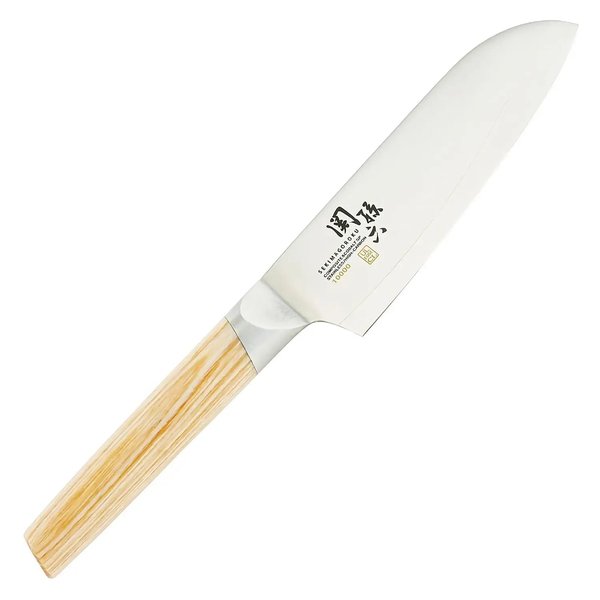
Best For: Premium all-rounder from Japan's biggest knife brand
Kai's 10000CL sits at the top of the Seki Magoroku range. High-carbon stainless steel with a composite laminated construction delivers sharp cutting performance with good edge retention. The hon-toshi (full-through) tang provides balance that feels natural — the knife becomes an extension of your hand.
My Best (マイベスト) ranks this in their top 10 santoku knives. Kakaku.com users rate it 4.5/5 for "切れ味 (cutting performance)" and "バランス (balance)."
Pros:
- Premium steel within the Seki Magoroku range
- Full-through tang for exceptional balance
- Kai's nationwide warranty and support
Cons:
- ¥8,800 — premium pricing for a santoku
- Brand premium — you're partly paying for the name
- Competent but lacks artisan character
Price: ¥8,800 (~$57)
2. Shimomura Kogyo Verdun Santoku 165mm
Best For: The easiest-to-maintain santoku
 Source: Amazon Japan
LDK magazine (360life.shinyusha.co.jp) awarded the Verdun their top recommendation for home santoku knives. The seamless one-piece molybdenum vanadium stainless construction eliminates every maintenance concern: dishwasher safe, no wood handle to crack, no joints for bacteria.
At 130g, it's lighter than most santoku knives. The 165mm blade handles everything a home cook needs. At ¥2,800, it's the cheapest knife on this list — and one of the best.
Pros:
- LDK magazine top pick for home santoku
- Seamless one-piece — no hygiene concerns
- ¥2,800 with dishwasher compatibility
- 130g ultra-lightweight
Cons:
- Molybdenum vanadium dulls faster than VG-10
- No handle character — purely clinical design
- Light weight may feel insubstantial to some
Price: ¥2,800 (~$18)
3. Global G-46 Santoku 180mm
Best For: Design-forward santoku with worldwide reputation
 Source: Amazon
The Global G-46 brings the same iconic one-piece CROMOVA 18 stainless design to the santoku format. The 180mm blade is slightly longer than standard santoku (170mm), giving it extra reach. The hamaguri-ba (clam shell) convex edge profile maintains sharpness longer than flat-ground alternatives.
Best Present Guide (ベストプレゼントガイド) consistently ranks Global santoku among the top knife gifts in Japan. The distinctive design makes it a statement piece on any magnetic knife rack.
Pros:
- Iconic one-piece stainless design
- 180mm length gives extra reach vs. standard santoku
- Hamaguri-ba edge for extended sharpness
Cons:
- CROMOVA 18 steel is softer than VG-10
- ¥9,900 — premium for a santoku
- Smooth handle can feel slippery when wet
Price: ¥9,900 (~$65)
4. Yakucel Premio MODERN Santoku SC
Best For: LDK's #1 tested santoku for cutting performance
Yakucel's Premio MODERN earned the #1 spot in LDK/360life's 2026 santoku testing. The testing panel found it cut meat and vegetables with minimal effort, and the edge held its sharpness through extended testing sessions.
The all-stainless design with a modern handle aesthetic appeals to cooks who want a knife that looks as good as it cuts. Available through major Japanese retailers and increasingly popular on Rakuten.
Pros:
- #1 in LDK's professional cutting tests
- Excellent edge retention in testing conditions
- Modern design aesthetic
Cons:
- Less established brand than Kai or Global
- Limited availability outside Japan
- Higher price than some VG-10 alternatives
Price: ¥6,500 (~$42)
5. Kai Seki Magoroku Benifuji Santoku 165mm
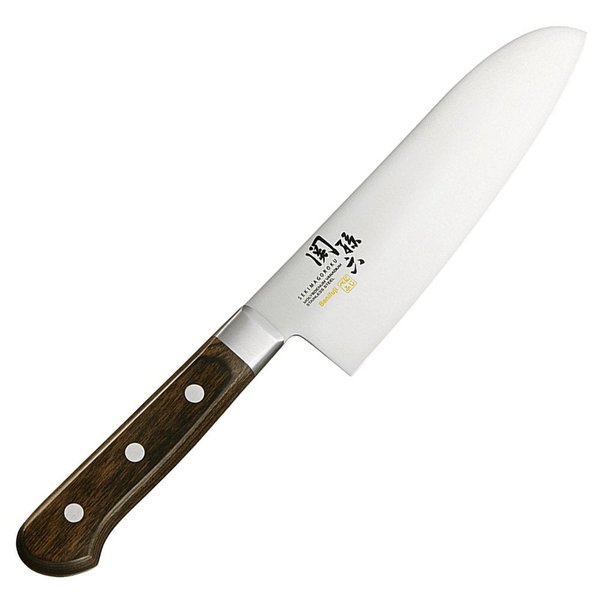
Best For: Best value from the Seki Magoroku range
The Benifuji sits at Kai's sweet spot — high enough quality to satisfy serious home cooks, low enough price to be accessible. Molybdenum vanadium steel with a laminated wood handle (積層強化木柄) provides a warm, traditional feel. The hon-toshi tang construction ensures excellent weight distribution.
Houcyou.com recommends the Benifuji as the single best Seki Magoroku model under ¥5,000.
Pros:
- Excellent price-to-quality ratio within Seki Magoroku
- Laminated wood handle with moisture resistance
- Full-through tang for proper balance
Cons:
- Molybdenum vanadium dulls faster than VG-10
- More frequent sharpening needed
- Standard performer — nothing exceptional
Price: ¥4,500 (~$29)
6. Kyowa Kogyo Stone Barrier Light Type Santoku
Best For: Non-stick coating for food release
Kyowa Kogyo's Stone Barrier earned #2 in LDK's santoku testing. The unique stone-like coating on the blade surface reduces food adhesion — sliced potatoes, onions, and soft cheese release from the blade instead of sticking.
This addresses one of the most common home cook complaints: having to peel stuck food off the blade between cuts.
Pros:
- Non-stick blade coating for food release
- #2 in LDK professional testing
- Unique value proposition among santoku knives
Cons:
- Coating degrades over time with use and sharpening
- Underlying steel is standard — nothing special without the coating
- Novelty feature may not justify the price long-term
Price: ¥5,500 (~$36)
7. Misashi Riverline Santoku
Best For: Artisan quality from Seki City
Misashi's (三星刃物) Riverline santoku earned #3 in LDK's testing. Made in Seki City with attention to blade geometry and edge quality. The company focuses on a small product line, allowing more attention per knife than mass-production brands.
Pros:
- #3 in LDK professional testing
- Focused Seki City manufacturer
- Quality blade geometry and edge finish
Cons:
- Less brand recognition than Kai or Global
- Limited product line means fewer options
- Primarily available in Japan
Price: ¥5,800 (~$38)
8. Tojiro DP F-503 Santoku 170mm
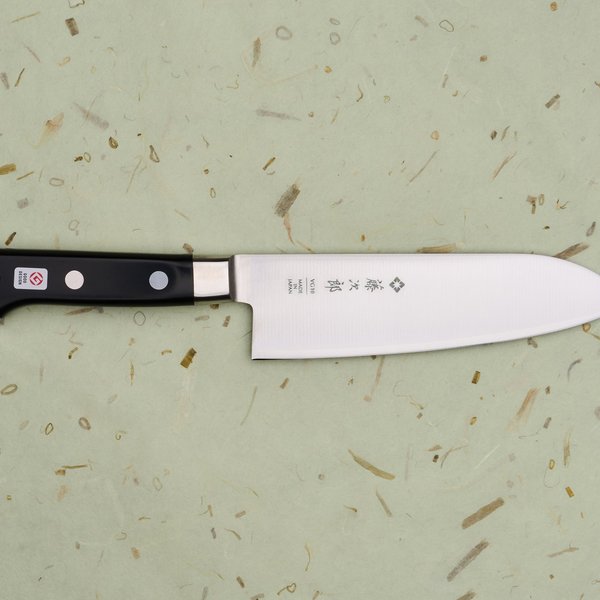
Best For: VG-10 santoku at a budget price
Tojiro brings their acclaimed 3-ply VG-10 clad construction to the santoku format. The same honwarikomi method used in their gyuto line — VG-10 core sandwiched between stainless cladding — delivers premium steel performance at a Tojiro price.
KOHNO Media recommends this alongside the Tojiro DP gyuto for users building a two-knife set.
Pros:
- VG-10 3-ply clad — premium steel at budget price
- Full tang with triple-rivet handle
- Part of the well-regarded Tojiro DP line
Cons:
- Handle design is functional but plain
- Less refined finish than pricier santoku
- Slightly heavier than competitors
Price: ¥6,200 (~$40)
9. Kanetsugu Classic Hammered Wa Santoku 175mm
Best For: Traditional Japanese aesthetics
 Source: JapaneseChefsKnife.com
Kanetsugu's hammered (槌目, tsuchime) finish santoku with a traditional wa handle brings artisan beauty to the santoku category. The hammered texture reduces food adhesion (like the Stone Barrier, but through physics rather than coating), and the wa handle provides the authentic Japanese knife experience.
JapaneseChefsKnife.com features this in their santoku collection for Western buyers seeking traditional Japanese aesthetics.
Pros:
- Hammered finish reduces food adhesion naturally
- Traditional wa handle for authentic Japanese feel
- Beautiful artisan aesthetics
Cons:
- Wa handles require hand-washing only
- Hammered finish can trap residue if not cleaned properly
- Higher price for the aesthetic premium
Price: ¥8,500 (~$55) | JapaneseChefsKnife.com
10. Basara Star (成國作) Santoku
Best For: Budget reliability with bolster design
The Basara Star from Narikuni-saku uses molybdenum vanadium stainless steel with a bolster — the metal guard between blade and handle that prevents fingers from sliding onto the edge. The bolster design is common in Western knives but rare in Japanese santoku, making this a good transition knife for users coming from European cutlery.
Kinarino.jp includes this in their recommended 30 santoku knives for its safety-focused design.
Pros:
- Bolster provides safety against finger slippage
- Good transition knife from Western to Japanese cutlery
- Clean, hygienic construction
Cons:
- Molybdenum vanadium steel is entry-level
- Bolster makes full-blade sharpening more difficult
- Budget build quality
Price: ¥3,200 (~$21)
FAQ
What's the ideal santoku blade length?
165-170mm is the Japanese standard. Some brands offer 180mm for cooks who want extra reach. Shorter blades (150mm) exist but sacrifice versatility. For most home cooks, 170mm is the sweet spot — enough blade for efficient chopping without taking up excessive counter space.
Santoku vs. nakiri for vegetables?
Santoku handles meat, fish, and vegetables (the "three virtues"). Nakiri is a dedicated vegetable knife with a flat blade profile optimized for up-and-down chopping. If vegetables are 80%+ of your cooking, a nakiri is superior. For general-purpose cooking, santoku is more versatile. See our nakiri vs. usuba comparison.
Can I rock-chop with a santoku?
Yes, but it's not the intended motion. Santoku knives are designed for the push-cut (forward and down) technique common in Japanese cooking. The curved kamagata tip does allow some rocking motion, but less than a gyuto or Western chef's knife. If rock-chopping is your primary technique, a gyuto is a better choice.
Is a santoku good for left-handed users?
Most santoku knives are double-bevel (symmetrically ground), making them suitable for both left and right-handed users. Check the grind ratio — some knives marketed as "double bevel" have a 70/30 or 60/40 asymmetric grind that favors right-handed use. True 50/50 grinds work equally well for both hands.
How does santoku compare to a Chinese cleaver?
Both are wide, flat-bladed knives designed for vegetables. The Chinese cleaver (菜刀) is significantly heavier, thicker, and uses a different cutting technique (weight-assisted drop-cutting). Santoku is lighter and more precise. They serve different cooking traditions — choose based on what you cook most often.
Related Reading
- Gyuto vs. Santoku: The Knife Japan's Home Cooks Actually Use
- Nakiri vs. Usuba: Japanese Vegetable Knives Explained
- Japanese Kitchen Knife Buying Guide: What to Know Before Your First Purchase
-- The Japanese Knives Team