Top 5 Japanese Knife Makers Under ¥10,000: Budget Picks from Kakaku.com
Japanese knives under ¥10,000 occupy one of the most interesting spaces in the cutlery world. This is the price range where Japan's manufacturing advantages — mature industrial clusters in Seki and Tsubame-Sanjo, centuries of metallurgical knowledge, and fierce domestic competition — create knives that are genuinely difficult to beat at any price point worldwide.
Quick Answer
- The best-value Japanese knife under ¥10,000 is the Tojiro DP series (¥4,400–¥5,500) — VG-10 cobalt alloy steel, HRC 60, three-layer laminate construction from Tsubame-Sanjo. It consistently ranks in Kakaku.com's top 10 and outperforms German knives at double the price
- Kai's Seki Magoroku line offers the widest range under ¥10,000, from the entry-level Wakatake (¥1,500) to the mid-range Benifuji (¥3,345) and Momoyama (¥4,000) — all produced in Seki, Gifu, Japan's largest knife-manufacturing city
- Yaxell Premio MODERN santoku earned the #1 spot in LDK (Japan's leading product testing magazine) for sustained cutting performance and ergonomics, with models available for ¥3,000–¥5,000
- At the ¥8,000–¥10,000 ceiling, you can reach Damascus-clad knives and artisan-adjacent construction from brands like Tadafusa and Tojiro Flash — quality levels that would cost ¥20,000+ from European makers
The Sweet Spot: Why ¥5,000–¥10,000 Japanese Knives Punch Above Their Weight
 Source: Hocho-Knife.com
Japanese knives under ¥10,000 occupy one of the most interesting spaces in the cutlery world. This is the price range where Japan's manufacturing advantages — mature industrial clusters in Seki and Tsubame-Sanjo, centuries of metallurgical knowledge, and fierce domestic competition — create knives that are genuinely difficult to beat at any price point worldwide.
Consider what ¥5,000 (roughly $33 USD) buys you in the Japanese domestic market: a VG-10 cobalt alloy steel blade, hardened to HRC 60, with a three-layer laminated construction and a factory-sharpened edge at 15 degrees per side. That same specification from a European maker would cost €80–€120. From an American custom maker, you'd be looking at $200+.
The difference isn't subsidies or corner-cutting. It's ecosystem economics. Seki has hundreds of knife manufacturers competing for the same domestic market. Tsubame-Sanjo has shared heat-treatment facilities and grinding specialists that serve multiple makers. Kakaku.com makes pricing transparent, so no manufacturer can charge premium prices for average construction. The result: relentless downward pressure on pricing, with quality as the competitive differentiator.
This article profiles five knife makers — all under ¥10,000 for their core products — ranked by value and quality. All pricing and product information is sourced from Japanese-language retail sites, Kakaku.com, My Best (Japan's product testing authority), and manufacturer websites.
The Rankings: 5 Best Japanese Knife Makers Under ¥10,000
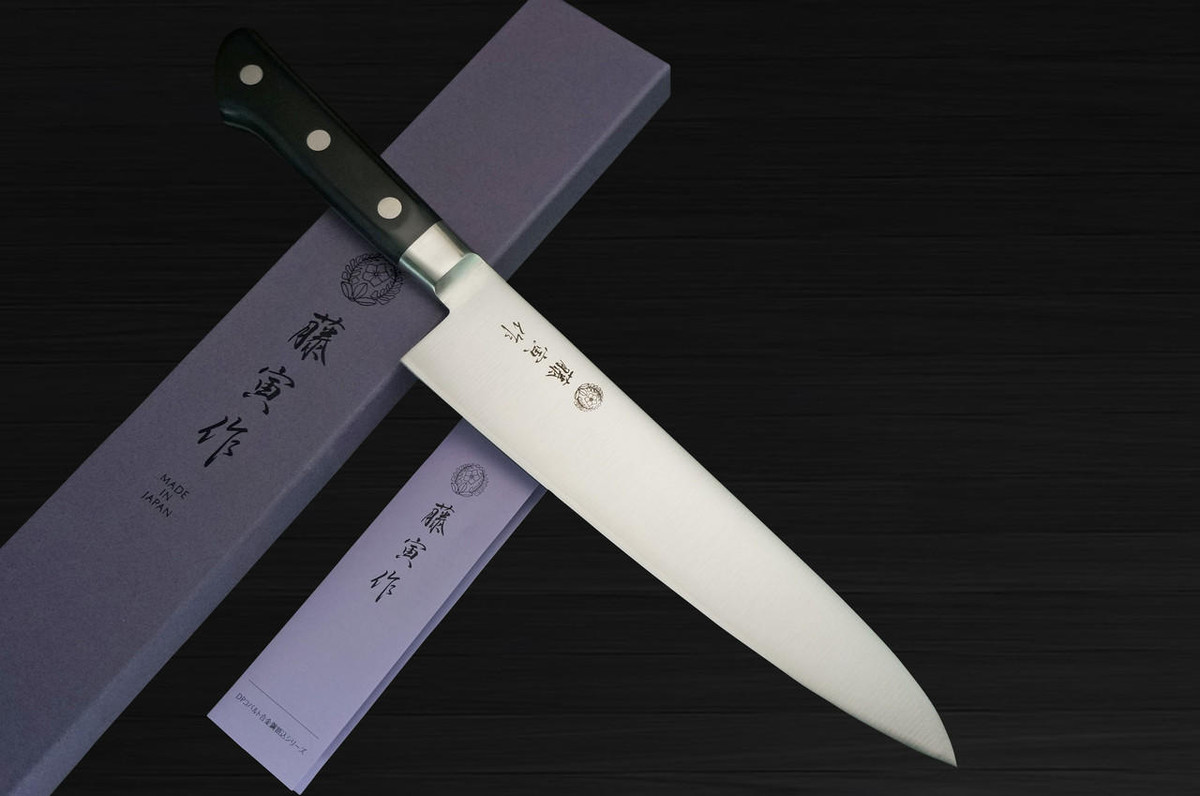
#1: Tojiro (藤次郎) — The Undisputed Value Champion
Headquarters: Tsubame, Niigata (Tsubame-Sanjo region) Founded: 1953 Key series: Tojiro DP (DPコバルト合金鋼割込) Price range: ¥1,500–¥11,000 (most popular models under ¥6,000)
Tojiro is the knife that knife nerds recommend to everyone who asks "what's the best knife I can buy without spending a fortune?" And they're right. The Tojiro DP series has been the benchmark for value-oriented Japanese knives for over a decade, and no competitor has managed to dethrone it.
What makes Tojiro DP special:
The blade uses VG-10 cobalt alloy steel — the same high-end stainless steel found in knives costing ¥15,000–¥25,000 from other makers. VG-10 contains cobalt, vanadium, and molybdenum in addition to the standard chromium and carbon, giving it an unusual combination of hardness (HRC 60), corrosion resistance, and edge retention. It's the steel that put Japanese stainless knives on the map internationally.
The construction is three-layer laminate (sanmai): a VG-10 core flanked by softer stainless cladding on both sides. The cladding protects the harder core from lateral stress (reducing chipping risk) and rust, while the core provides the cutting edge. This is the same construction principle used in premium Sakai knives — just with stainless components instead of carbon steel and soft iron.
Heat treatment achieves HRC 60 — higher than most German knives (HRC 54–56) and higher than many Japanese knives at this price point. The hardness means the edge holds its angle longer between sharpenings.
Top picks under ¥10,000:
| Model | Type | Size | Steel | Price (approx.) |
|---|---|---|---|---|
| F-808 | Santoku | 170mm | VG-10 | ¥4,400 |
| F-807 | Gyuto | 180mm | VG-10 | ¥5,500 |
| F-809 | Gyuto | 210mm | VG-10 | ¥6,600 |
| F-883 | Petty | 130mm | VG-10 | ¥3,300 |
| F-895 | Bread knife | 215mm | VG-10 | ¥5,500 |
| Economy series | Santoku | 170mm | MoV stainless | ¥1,500–¥2,000 |
The F-808 santoku and F-807 gyuto are the two most recommended Tojiro products across Japanese review sites. On Kakaku.com, Tojiro knives consistently appear in the top 10 most-popular kitchen knives category, competing against brands with much higher marketing budgets (Source: kakaku.com, "包丁の人気商品ランキング 2026年3月").
The handle situation: The main criticism of the Tojiro DP series is the handle. It uses "eco-wood" (tsumiki) — a compressed laminate that looks and feels utilitarian. It's functional and durable, but it lacks the aesthetic warmth of natural wood or the heft of a riveted Western handle. At this price point, the handle is where Tojiro saves money. It's a reasonable trade-off — you're getting ¥15,000 blade construction with a ¥2,000 handle.
For a deep look at Tojiro and the broader Tsubame-Sanjo knife ecosystem, see our Tsubame-Sanjo guide.
Our verdict: If you buy one knife from this list, make it a Tojiro DP. The performance-per-yen is unmatched.
#2: Kai / Seki Magoroku (貝印 / 関孫六) — The Widest Range at Every Budget
Headquarters: Seki, Gifu Prefecture Founded: 1908 Key series: Seki Magoroku (関孫六) — multiple sub-lines Price range: ¥1,000–¥12,000+ (most popular models under ¥5,000)
Kai Group is Japan's largest knife and blade manufacturer — the company behind razors, scissors, medical scalpels, and kitchen knives sold in over 100 countries. Their kitchen knife brand, Seki Magoroku (関孫六, named after the legendary Muromachi-era swordsmith Magoroku Kanemoto), offers one of the broadest product lines in the industry.
The genius of Seki Magoroku is its tiered sub-line structure, which gives buyers a clear upgrade path within a single brand:
Seki Magoroku sub-lines under ¥10,000:
| Sub-line | Steel | Handle | Price Range | Best For |
|---|---|---|---|---|
| Wakatake (わかたけ) | MoV stainless | Resin | ¥1,200–¥1,800 | Absolute beginners, budget buyers |
| Moegi (萌黄) | Stainless | Resin | ¥1,500–¥2,500 | Students, first apartments |
| Akane (茜) | High-carbon stainless | Resin | ¥1,800–¥3,000 | Everyday home cooking |
| Momoyama (桃山) | Carbon steel composite | Wood | ¥3,500–¥4,500 | Serious home cooks wanting carbon |
| Benifuji (べにふじ) | High-carbon MV stainless | Wood | ¥3,000–¥4,000 | Best wood-handle value |
| Aofuji (青藤) | High-carbon MV stainless | Laminated wood | ¥4,000–¥5,000 | Upgrade from Benifuji |
| Seki Magoroku Composite (関孫六 コンポジット) | Stainless/carbon composite | Stainless + resin | ¥4,000–¥6,000 | Modern design, durability |
| Shoso (匠創) | High-carbon stainless | All-stainless seamless | ¥3,000–¥5,000 | Hygiene-conscious cooks |
| Damascus (ダマスカス) | Stainless + Damascus cladding | Laminated wood | ¥8,000–¥12,000 | Enthusiasts wanting aesthetics |
Standout model: Seki Magoroku Momoyama (桃山)
The Momoyama is a sleeper hit. It uses a carbon steel composite construction — a carbon steel core with stainless cladding — at a price point (approximately ¥4,000 for a santoku) where most competitors offer pure stainless. The carbon core provides cutting performance that "stainless knives in the same price range simply cannot match" according to home knife review site modama.net (Source: modama.net, "家庭用のおすすめ包丁"). The blade has a hammered (tsuchime) pattern that improves food release and gives the knife a distinctly Japanese artisan look.
Standout model: Seki Magoroku Shoso (匠創)
The Shoso series uses an all-stainless, seamless construction — blade and handle are one continuous piece of steel, with no joints or rivets where bacteria can hide. Kai's proprietary "special thinning process" (tokushu suki kakou) reduces the blade's weight and cross-sectional thickness, allowing lighter cuts with less effort. It's the most hygienic design in Kai's lineup and is popular in professional settings where sanitation standards are strict. Prices start at approximately ¥3,000 for a santoku.
Kai's official buying guide recommends choosing by production region, price, and brand characteristics — emphasizing that the best knife is the one that matches your cooking style, not necessarily the most expensive one (Source: kai-group.com, "包丁の選び方のポイント").
For context on Kai's home base of Seki and how it compares to other knife-making regions, see our Sakai vs. Seki vs. Echizen guide.
Our verdict: Best brand for buyers who want options. The Momoyama is the hidden gem; the Shoso is the hygiene pick; the Wakatake is the unbeatable budget entry.
#3: Yaxell (ヤクセル) — The Testing Lab Favorite
Headquarters: Seki, Gifu Prefecture Founded: 1932 Key series: Premio MODERN, Tsubakih Price range: ¥2,500–¥8,000 (core models)
Yaxell doesn't have the brand recognition of Kai or Tojiro, but it keeps winning in blind testing. The Yaxell Premio MODERN Santoku SC earned the #1 Best Buy designation in LDK Magazine's (Japan's leading independent product testing publication) comprehensive knife comparison, beating out 19 competitors on sustained cutting ability and ease of use (Source: 360life.shinyusha.co.jp, "包丁のおすすめ人気ランキング19選").
What makes Yaxell stand out:
Yaxell's strength is ergonomics. Where Tojiro focuses on blade steel and Kai focuses on range, Yaxell invests in handle design and blade balance. The Premio MODERN series features:
- Contoured stainless handle with finger grooves that position your hand naturally
- Balanced weight distribution — neither handle-heavy nor blade-heavy
- Proprietary "SC" edge (Sharp & Clean) that maintains sharpness through extended use
- Molybdenum vanadium stainless steel blade with good corrosion resistance
Top picks under ¥10,000:
| Model | Type | Size | Price (approx.) |
|---|---|---|---|
| Premio MODERN SC | Santoku | 165mm | ¥3,500–¥4,500 |
| Premio MODERN SC | Gyuto | 180mm | ¥4,000–¥5,000 |
| Tsubakih | Santoku | 165mm | ¥5,000–¥6,500 |
| Tsubakih | Gyuto | 180mm | ¥5,500–¥7,000 |
The Tsubakih (椿) series sits above the Premio MODERN and uses a higher-grade stainless steel with a more refined handle. At ¥5,000–¥7,000, it competes directly with the Tojiro DP on performance while offering a more polished aesthetic.
The LDK test methodology: LDK magazine tests knives on standardized cutting tasks — slicing tomatoes, cutting squash, mincing cabbage — and scores on initial sharpness, sustained sharpness (after 200+ cuts), handle comfort, balance, and cleaning ease. The Premio MODERN SC scored highest on the composite metric, with particular strength in "sharpness that lasts" — the A-rating noted that the knife maintained its cutting ability longer through extended testing than higher-priced competitors (Source: 360life.shinyusha.co.jp).
Our verdict: Best choice if handle comfort and ergonomics are your priority. The Premio MODERN SC is an excellent first knife for someone who doesn't want to think about anything except cooking.
#4: Masahiro (正広) — The Professional's Budget Pick
Headquarters: Seki, Gifu Prefecture Founded: 1948 Key series: Masahiro MV, Masahiro Stainless Price range: ¥3,000–¥10,000 (professional-grade starts at ¥5,000)
Masahiro occupies a unique niche: it's the brand that professional chefs buy when they need a dependable workhorse knife at a reasonable price. While Sakai's artisan knives command the luxury end, Masahiro serves the working professional who needs a knife that can handle 8+ hours of daily service without babying.
What makes Masahiro different:
Masahiro's engineering philosophy prioritizes edge retention and durability over raw sharpness. Their proprietary stainless steels are heat-treated to achieve a balance where the knife stays sharp through a full professional service (lunch + dinner, roughly 200–500 cuts per day) before needing a touch-up on the whetstone.
Their technical documentation states: "The factors that create sharpness are the 'blade angle' and the 'blade tip condition' — with a focus on both the acute angle of the cutting edge and the smoothness of the finished surface" (Source: masahiro-hamono.com, "切れ味について").
Top picks under ¥10,000:
| Model | Type | Size | Steel | Price (approx.) |
|---|---|---|---|---|
| Masahiro MV-H | Santoku | 175mm | MoV Honyaki stainless | ¥5,500 |
| Masahiro MV-H | Gyuto | 180mm | MoV Honyaki stainless | ¥6,000 |
| Masahiro MV-H | Gyuto | 210mm | MoV Honyaki stainless | ¥7,500 |
| Masahiro Stainless | Santoku | 170mm | Standard stainless | ¥3,500 |
| Masahiro MV-L | Petty | 120mm | MoV stainless | ¥3,000 |
The MV-H (MoV Honyaki) line is Masahiro's standout: a molybdenum-vanadium stainless steel blade with a mono-steel (honyaki) construction — meaning the entire blade is made from one piece of steel, without cladding or lamination. Mono-steel construction is traditionally associated with the most expensive Japanese knives (carbon steel honyaki knives can cost ¥50,000–¥200,000+). Masahiro achieves it in stainless at ¥5,500–¥7,500 by using modern Seki manufacturing infrastructure.
Professional endorsement: Masahiro is a standard-issue brand in Japanese culinary schools and hotel kitchens. If you've eaten at a mid-range to upscale hotel restaurant in Japan, there's a good chance your food was prepared with Masahiro knives.
Our verdict: Best choice for cooks who value durability and professional pedigree over flashy aesthetics. The MV-H gyuto at ¥6,000 is an exceptionally well-balanced knife.
#5: Tadafusa (庖丁工房タダフサ) — The Artisan Entry Point
Headquarters: Sanjo, Niigata (Tsubame-Sanjo region) Founded: 1948 Key series: Basic 3 (基本の3本), Next 1 (次の1本) Price range: ¥7,150–¥10,450 (individual knives)
Tadafusa sits at the top of the under-¥10,000 range and represents a fundamentally different proposition than the other four makers on this list. Where Tojiro, Kai, Yaxell, and Masahiro are industrial manufacturers producing thousands of knives per month, Tadafusa is a small workshop in Sanjo City that makes knives in small batches with significant hand-finishing.
What you're paying for:
SLD steel core — SLD (Steel for Cold Die) is a high-carbon, high-chromium tool steel that's harder than VG-10 (approximately HRC 62–63 vs. HRC 58–60). It holds its edge longer and takes a keener edge, but it's more brittle and requires more careful use. The SLD core is sandwiched in a three-layer stainless laminate, so you get the performance of a semi-carbon steel with the corrosion resistance of stainless on the blade faces.
Patented carbonized chestnut wood handle — Tadafusa's signature. Chestnut wood is smoked in a furnace until it reaches just short of charcoal — a process called kokin tanka moku (抗菌炭化木). The result is naturally antibacterial, water-resistant, and has a distinctive dark matte finish. The handle shape is rounded and ergonomic, designed specifically to fit comfortably in female hands — smaller, lighter, and less aggressive than the angular handles on most Japanese knives (Source: nakagawa-masashichi.jp, "庖丁工房タダフサ").
The "Basic 3" concept — Tadafusa's product line is organized around a philosophy: start with three essential knives (santoku, petty, bread knife), master them, then add one specialist knife ("Next 1") from a curated selection (nakiri, gyuto, ko-deba, paring). This structured approach appeals to cooks who want guidance rather than an overwhelming catalog.
Pricing for knives under ¥10,000:
| Model | Type | Size | Steel | Price (approx.) |
|---|---|---|---|---|
| Basic 3: Petty | Petty | 130mm | SLD/stainless clad | ¥7,150 |
| Basic 3: Bread knife | Bread | 230mm | SLD/stainless clad | ¥8,800 |
| Basic 3: Santoku | Santoku | 170mm | SLD/stainless clad | ¥9,350 |
| Next 1: Paring | Paring | 90mm | SLD/stainless clad | ¥6,600 |
Only the petty, bread knife, and paring knife fall under the strict ¥10,000 ceiling. The santoku at ¥9,350 squeaks in. But even the santoku represents extraordinary value for what you get — hand-finished SLD steel with a patented handle material from a heritage workshop.
Longevity claim: Tadafusa customers have reported using the same knife for 30–40 years, passed down through generations. As long as the SLD steel core remains, the knife can be resharpened indefinitely — and the carbonized chestnut handle resists water damage that would destroy a standard magnolia handle in a fraction of the time (Source: things-niigata.jp, "庖丁工房タダフサの鋼包丁").
For more on Tadafusa and the Tsubame-Sanjo knife-making ecosystem, see our Tsubame-Sanjo guide.
Our verdict: Best choice for design-conscious buyers who want genuine artisan quality at the top of the budget range. The petty (¥7,150) is the lowest-entry Tadafusa knife and makes an excellent first encounter with the brand.
Comparison Table: All 5 Makers Head-to-Head
 Source: Hocho-Knife.com
| Factor | Tojiro DP | Kai Seki Magoroku | Yaxell Premio | Masahiro MV-H | Tadafusa |
|---|---|---|---|---|---|
| Best model under ¥10K | F-808 Santoku | Momoyama Santoku | Premio SC Santoku | MV-H Santoku | Petty 130mm |
| Price | ¥4,400 | ¥4,000 | ¥3,500–¥4,500 | ¥5,500 | ¥7,150 |
| Steel | VG-10 | Carbon composite | MoV stainless | MoV Honyaki | SLD/stainless clad |
| Hardness | HRC 60 | HRC 58–60 | HRC 56–58 | HRC 58–59 | HRC 62–63 |
| Construction | 3-layer laminate | 3-layer laminate | Mono-steel | Mono-steel | 3-layer laminate |
| Handle | Eco-wood | Wood or resin | Contoured stainless | Rosewood/resin | Carbonized chestnut |
| Made in | Tsubame-Sanjo | Seki | Seki | Seki | Tsubame-Sanjo |
| Best for | Pure value | Options/range | Ergonomics | Durability | Design/artisan |
| Weakness | Plain handle | Steel varies by sub-line | Lower hardness | Less exciting aesthetics | Higher price point |
Buying Strategy: How to Maximize Value Under ¥10,000
The One-Knife Budget (¥3,000–¥5,500)
If you're buying one knife and want the best possible blade for your money:
- Tojiro DP F-808 Santoku (¥4,400) — VG-10, HRC 60, three-layer laminate. The undisputed value champion.
- Kai Seki Magoroku Momoyama Santoku (¥4,000) — Carbon composite with hammered finish. Better aesthetics and food release than Tojiro.
- Yaxell Premio MODERN SC Santoku (¥3,500) — Best ergonomics, LDK #1 tested.
The Two-Knife Budget (¥6,000–¥10,000)
If you can afford two knives, the optimal combination is:
- Santoku or Gyuto (¥4,000–¥5,500) + Petty (¥2,500–¥3,500)
This covers 95% of home cooking tasks. The santoku/gyuto handles all main prep; the petty handles detail work (peeling, coring, small cuts, garnish). For a breakdown of which main knife suits your cooking style, see our santoku vs. gyuto comparison.
The Upgrade Strategy
Start with a Tier 2 knife (¥3,000–¥5,500). Cook with it for 6–12 months. Learn to sharpen on a whetstone (see our sharpening guide). Then, if you want to explore further:
- For carbon steel: Try a Kai Seki Magoroku Momoyama (carbon composite, ¥4,000) — it gives you a taste of carbon steel performance without full maintenance burden
- For artisan quality: Save for a Tadafusa santoku (¥9,350) — the SLD steel and carbonized handle are a genuine step up
- For specialized knives: Add a nakiri for vegetables or a deba for fish — both available from Kai and Tojiro under ¥5,000
Where to Buy for Best Prices
Kakaku.com is essential for price comparison. The same Tojiro DP F-808 might be ¥4,400 at one retailer and ¥3,900 at another — Kakaku.com finds the lowest price instantly. Our Kakaku.com rankings guide explains how to navigate the site.
Amazon.co.jp offers convenience and fast shipping but verify the seller — stick to items sold by Amazon.co.jp directly or authorized dealer storefronts. Counterfeit knives exist, especially for popular models.
Manufacturer direct stores (tojiro.net, tadafusa.net) guarantee authenticity at standard retail pricing.
Rakuten often runs point campaigns that effectively discount purchases by 10–20% — worth checking during Super Sale events.
Honorable Mentions: Other Brands Worth Considering
 Source: Hocho-Knife.com
A few other makers produce excellent knives under ¥10,000 that didn't make the top 5 but deserve mention:
Kyocera (京セラ) — Japan's leading ceramic knife manufacturer. Ceramic blades never rust, never need sharpening (the edge lasts 10x longer than steel), and are completely non-reactive with food. The downside: ceramic is brittle and will shatter if dropped or used on hard materials. The Kyocera Fine Premier series santoku (¥4,000–¥6,000) is an excellent option for cooks who want zero maintenance. Not a traditional Japanese knife, but a legitimate alternative.
Global (グローバル) — Designed by industrial designer Komin Yamada and manufactured in Niigata, Global's all-stainless-steel knives are iconic for their dimpled handle and seamless construction. The G-46 santoku (approximately ¥9,000) is a design classic. The steel is CROMOVA 18 (HRC 56–58) — not as hard as VG-10, but the overall knife design and balance are excellent.
Misono (ミソノ) — A Seki-based maker that bridges the gap between industrial production and artisan work. Their entry-level Molybdenum series gyuto (approximately ¥6,000–¥8,000 for 180mm) is popular with culinary students. The UX10 series (Swedish stainless steel) is widely regarded as one of the best stainless gyuto knives in existence, though most UX10 models exceed ¥10,000.
Don't Forget the Whetstone
A ¥5,000 Japanese knife without a whetstone is a depreciating asset. The factory edge will dull in 2–4 weeks of daily use, and without proper sharpening, your expensive VG-10 blade will feel no better than a ¥500 knife from the 100-yen store.
Budget whetstone recommendations (under ¥3,000):
| Stone | Grit | Price (approx.) | Notes |
|---|---|---|---|
| King KW-65 | #1000/#6000 combination | ¥2,500 | The classic beginner stone — dual grit, good value |
| Suehiro Cerax 1000 | #1000 | ¥2,000 | Single grit, excellent splash-and-go convenience |
| Shapton Kuromaku #1000 | #1000 | ¥2,500 | Professional-grade, fast cutting, splash-and-go |
For ¥8,000–¥10,000 total (knife + stone), you have a complete, professional-capable sharpening setup that will last years. Our sharpening guide walks you through the technique.
Frequently Asked Questions
Is there really a big difference between a ¥1,500 knife and a ¥5,000 knife?
Yes — the difference is significant and tangible. At ¥1,500, you get basic MoV stainless steel (HRC 56–58) that dulls within 1–2 weeks of daily use. At ¥5,000, you get VG-10 or equivalent (HRC 60) that holds its edge for 3–4 weeks. The construction quality also jumps: laminated steel vs. mono-layer, better heat treatment consistency, tighter blade geometry. You'll feel the difference the moment you cut a tomato. The ¥1,500 knife is adequate; the ¥5,000 knife is genuinely impressive. Whether the step from ¥5,000 to ¥10,000 is worthwhile depends on your priorities — you're paying for aesthetics, handle quality, and marginal steel upgrades rather than a transformative performance leap.
Are these knives as good as expensive Sakai knives?
For different reasons, at different tasks — yes, absolutely. A Tojiro DP gyuto (¥5,500) won't outperform a ¥30,000 Sakai-made yanagiba at sashimi slicing. But for everyday cooking — chopping vegetables, slicing meat, mincing herbs — the Tojiro holds its own against knives costing 5x more. The performance gap narrows dramatically when you compare like-for-like tasks (double-bevel general-purpose cutting). For the full regional comparison, see our Sakai vs. Seki vs. Echizen guide.
Should I buy the cheapest Kai or the cheapest Tojiro?
If your budget is truly minimal (under ¥2,000), the Kai Seki Magoroku Wakatake (¥1,500) is the better buy — it's the most popular budget knife in Japan for a reason, and Kai's Seki manufacturing ensures consistent quality even at the entry level. If you can stretch to ¥4,000–¥5,500, the Tojiro DP is the clear winner — the VG-10 steel is a categorical upgrade over Kai's budget-line MoV. The sweet spot comparison is Kai Momoyama (¥4,000) vs. Tojiro DP F-808 (¥4,400) — both are excellent, with the Momoyama offering better aesthetics and the Tojiro offering harder steel.
Do any of these brands make good deba or yanagiba knives?
Kai and Tojiro both produce deba and yanagiba knives under ¥10,000, though the selection is more limited than for gyuto/santoku. Kai's Seki Magoroku Kanaju ST deba (¥4,490) and Tojiro's DP deba (approximately ¥5,000) are both solid entry-level options for home fish preparation. For serious sashimi work, you'd want to look at Sakai-made single-bevel knives in a higher price range. See our deba vs. garasuki guide and yanagiba guide for specialized knife recommendations.
Can I find these knives outside Japan?
Most of them, yes. Tojiro ships internationally from its own website (tojiro.net) and is available through Amazon in most countries. Kai/Seki Magoroku is distributed globally. Yaxell has a growing international presence. Masahiro and Tadafusa are harder to find outside Japan — you may need to order through a Japanese knife specialty retailer (like Japanese Knife Imports, Korin, or MTC Kitchen) or a forwarding service. Expect a 30–50% price premium over Japanese domestic prices due to shipping, import duties, and retailer markup.
Related Reading
- The 10 Best Japanese Knives on Kakaku.com: Translated Rankings and Reviews
- Tsubame-Sanjo: The Hidden Knife Capital of Japan
- Japanese Knife Care, Rust Prevention, and Maintenance Guide
— The Blade & Steel Team